

What Is The Genetic Makeup Of The Irish


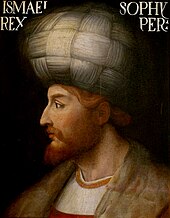
Ruddy pilus (also known as orange pilus and ginger hair) is a hair colour found in ane to 2 percent of the human population, appearing with greater frequency (two to six percent) among people of Northern or Northwestern European ancestry and lesser frequency in other populations. Information technology is most common in individuals homozygous for a recessive allele on chromosome xvi that produces an altered version of the MC1R protein.[1]
Carmine pilus varies in hue from a deep burgundy or bright copper, or auburn, to burnt orange or red-orange to strawberry blond. Characterized by high levels of the carmine pigment pheomelanin and relatively low levels of the night pigment eumelanin, it is associated with fair skin color, lighter eye color, freckles, and sensitivity to ultraviolet low-cal.[2]
Cultural reactions to reddish hair have varied from ridicule to admiration with many mutual stereotypes in existence regarding redheads. The term redhead has been in use since at to the lowest degree 1510.[3]
Geographic distribution
Modern
Northern and Western Europe

A British teenager with red hair
Ruby hair is most commonly found at the northern and western fringes of Europe;[iv] it is centred around populations in the British Isles and is particularly associated with the Celtic nations.[four]
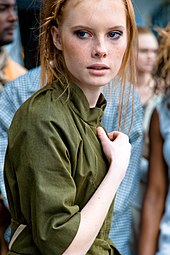
A young British woman with ruddy hair and freckles
Ireland has the highest number of ruddy-haired people per capita in the world with the percent of those with red pilus at around 10%.[5]
Not bad Uk likewise has a loftier pct of people with blood-red hair. In Scotland around 6% of the population has red hair; with the highest concentration of red caput carriers in the world found in Edinburgh, making it the red caput capital of the globe.[6] [7] In 1907, the largest ever report of hair colour in Scotland, which analysed over 500,000 people, found the pct of Scots with red pilus to be 5.iii%.[8] A 1956 report of hair color among British Regular army recruits also establish high levels of red hair in Wales and in the Scottish border counties of England.[fn i] [9]
Eastern and Southern Europe
In Italia, red pilus is plant at a frequency of 0.57% of the full population, without variation in frequency across the dissimilar regions of the country.[x] In Sardinia, cherry hair is institute at a frequency of 0.24% of the population.[x] Victorian era ethnographers considered the Udmurt people of the Volga Region in Russia to exist "the nearly red-headed men in the globe".[11] The Volga region however has one of the highest percentages of redheaded people.[12]
Red hair is too found amongst the Ashkenazi Jewish populations.[xiii] In 1903, v.6% of Smooth Jews had cerise hair.[14] Other studies have plant that 3.69% of Jewish women overall were found to have red hair, simply effectually 10.ix% of all Jewish men have reddish beards.[15] In European culture, before the 20th century, red pilus was often seen as a stereotypically Jewish trait: during the Castilian Inquisition, all those with red hair were identified as Jewish.[16] In Italy, red pilus was associated with Italian Jews, and Judas was traditionally depicted equally scarlet-haired in Italian and Spanish art.[17] The stereotype that cherry-red hair is Jewish remains in parts of Eastern Europe and Russia.[18]
Due north Africa and Mediterranean
The Berber populations of Kingdom of morocco[19] and northern Algeria have occasional redheads. Red hair frequency is especially significant among the Riffians from Morocco and Kabyles from Algeria,[xx] [21] [22] respectively.
Asia (all regions)

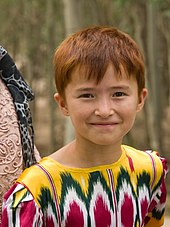
In Asia, red pilus tin can be found among some peoples of Afghan,[23] [24] Arab, Iranian, Mongolian, Turkic, Miao and Hmong descent.
Ancient human remains described as having red or auburn hair have been discovered in various parts of Asia including the Tarim mummies of Xinjiang, China.[25] Several preserved samples of human being hair have been obtained from an Iron Age cemetery in Khakassia, South Siberia. Many of the pilus samples appear ruby in color, and ane skull from the cemetery had a preserved reddish moustache.[26]
In the Volume of Wei, Chinese author Wei Shou notes that Liu Yuan was over six feet tall and had carmine strain[ clarification needed ] on his long beard.[27]
There are other examples of red pilus amid early Turkic people. Muqan Qaghan, the tertiary Qaghan of the Turkic Khaganate, was said to accept red hair and blue eyes.[28]
In Chinese sources, aboriginal Kyrgyz people were described every bit fair-skinned, dark-green- or blue-eyed and red-haired people with a mixture of European and East Asian features.[29]
The Kipchak people were a Turkic ethnic grouping from central Asia who served in the Gilded Horde military forces after beingness conquered by the Mongols. In the Chinese historical document 'Kang mu', the Kipchak people are described as carmine haired and blueish eyed.[xxx]
The ethnic Miao people of China are recorded with ruddy pilus. According to F.One thousand Savina of the Paris Strange missionary society the appearance of the Miao was pale yellow in their skin complexion, almost white, their hair color often existence light or nighttime brown, sometimes fifty-fifty red or corn-silk blond, and a few of them even have pale blue eyes.[31]
A phenotype study of Hmong People show they are sometimes born with red hair.[32]
Americas, Oceania and Sub-Saharan Africa

Mexican Boxer Santos "Canelo" Álvarez with red pilus. Álvarez has been nicknamed "Canelo" for his red locks, which is Spanish for cinnamon.[33]
Emigration from Europe has multiplied the population of red haired humans in the Americas, Commonwealth of australia, New Zealand and Due south Africa.[ citation needed ]
Historical

Several accounts by Greek writers mention redheaded people. A fragment by the poet Xenophanes describes the Thracians every bit blue-eyed and red-haired.[34] The aboriginal peoples Budini and Sarmatians are besides reported by Greek author to be blueish-eyed and red-haired, and the latter even owe their names to it.[35] [36]
In Asia, red or auburn hair has been found among the ancient Tocharians, who occupied the Tarim Basin in what is now the northwesternmost province of China. Tarim mummies accept been found with reddish hair dating to the 2nd millennium BC.[37]
Reddish-chocolate-brown (auburn) pilus is also found amongst some Polynesians, and is specially common in some tribes and family groups. In Polynesian civilisation reddish pilus has traditionally been seen as a sign of descent from high-ranking ancestors and a mark of rulership.[38] [39]
Biochemistry and genetics


Woman with mixed crimson-brown pilus, Papua New Guinea. Melanesians have a meaning incidence of mixed-fair hair, acquired by a genetic mutation dissimilar from European blond and ruddy hair.[40]
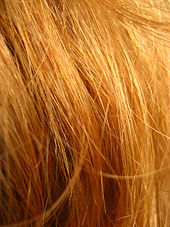
A close-up view of ruddy hair
The pigment pheomelanin gives red hair its distinctive color. Red hair has far more of the pigment pheomelanin than it has of the dark paint eumelanin.
The genetics of carmine hair announced to exist associated with the melanocortin-1 receptor (MC1R), which is found on chromosome sixteen. Lxxx percentage of redheads take an MC1R gene variant.[2] Red hair is also associated with off-white pare colour because the MC1R mutation also results in low concentrations of eumelanin throughout the body. The lower melanin concentration in peel confers the advantage that a sufficient concentration of of import Vitamin D can be produced nether low light conditions. However, when UV-radiations is stiff (as in regions close to the equator) the lower concentration of melanin leads to several medical disadvantages, such as a higher take chances of skin cancer. The MC1R variant gene that gives people red pilus generally results in skin that is difficult or impossible to tan. Because of the natural tanning reaction to the sun'southward ultraviolet light and high amounts of pheomelanin in the peel, freckles are a common just not universal feature of ruddy-haired people.
Red hair can originate from several changes on the MC1R-factor. If ane of these changes is present on both chromosomes then the corresponding private is probable to have scarlet hair. This type of inheritance is described as an autosomal recessive. Even if both parents exercise not have red hair themselves, both tin can be carriers for the gene and have a redheaded kid.
Genetic studies of dizygotic (fraternal) twins point that the MC1R gene is non solely responsible for the carmine hair phenotype; unidentified modifier genes be, making variance in the MC1R factor necessary, but not sufficient, for red hair production.[41]
Genetics
The alleles Arg151Cys, Arg160Trp, Asp294His, and Arg142His on MC1R are shown to be recessives for the red hair phenotype.[42] The factor HCL2 (besides called RHC or RHA) on chromosome 4 may also exist related to red hair.[43] [44] There are at least 8 genetic differences associated with cherry hair colour.[45] [46]
In species other than primates, scarlet hair has different genetic origins and mechanisms.
Development
Origins
Scarlet hair is the rarest natural pilus color in humans. The non-tanning pare associated with red pilus may have been advantageous in far-northern climates where sunlight is deficient. Studies by Bodmer and Cavalli-Sforza (1976) hypothesized that lighter skin pigmentation prevents rickets in colder climates by encouraging higher levels of vitamin D product and also allows the individual to retain estrus better than someone with darker skin.[47] In 2000, Harding et al. ended that red hair is not the result of positive selection but of a lack of negative option. In Africa, for example, red hair is selected against because high levels of lord's day damage stake skin. However, in Northern Europe this does not happen, so redheads can become more mutual through genetic drift.[42]
Estimates on the original occurrence of the currently agile factor for red hair vary from twenty,000 to 100,000 years ago.[48] [49]
A DNA report has ended that some Neanderthals also had red hair, although the mutation responsible for this differs from that which causes ruby hair in modern humans.[l]
Extinction hoax
A 2007 written report in The Courier-Mail service, which cited the National Geographic magazine and unnamed "geneticists", said that red pilus is likely to die out in the near future.[51] Other blogs and news sources ran similar stories that attributed the research to the magazine or the "Oxford Pilus Foundation". Still, a HowStuffWorks commodity says that the foundation was funded by hair-dye maker Procter & Take a chance, and that other experts had dismissed the research as either lacking in evidence or only bogus. The National Geographic article in fact states "while redheads may reject, the potential for cherry-red isn't going abroad".[52]
Crimson pilus is acquired by a relatively rare recessive allele (variant of a gene), the expression of which tin skip generations. It is non likely to disappear at whatever time in the foreseeable future.[52]
Medical implications of the ruby hair gene
Melanoma
Melanin in the peel aids UV tolerance through suntanning, but blanched persons lack the levels of melanin needed to preclude UV-induced DNA-damage. Studies have shown that cherry pilus alleles in MC1R increment freckling and decrease tanning ability.[53] Information technology has been plant that Europeans who are heterozygous for red pilus exhibit increased sensitivity to UV radiations.[54]
Red pilus and its relationship to UV sensitivity are of interest to many melanoma researchers. Sunshine tin both be good and bad for a person's health and the different alleles on MC1R represent these adaptations. It besides has been shown that individuals with stake skin are highly susceptible to a variety of skin cancers such as melanoma, basal cell carcinoma, and squamous jail cell carcinoma.[55] [56]
Pain tolerance and injury
Two studies have demonstrated that people with red hair have dissimilar sensitivity to hurting to people with other hair colors. One study found that people with red hair are more than sensitive to thermal pain (associated with naturally occurring low vitamin K levels),[57] while another study concluded that redheads are less sensitive to pain from multiple modalities, including baneful stimuli such every bit electrically induced hurting.[58] [59] [60]
Researchers take constitute that people with blood-red hair require greater amounts of anesthetic.[61] Other research publications have concluded that women with naturally ruddy hair require less of the painkiller pentazocine than exercise either women of other pilus colors or men of any hair colour. A written report showed women with reddish pilus had a greater analgesic response to that particular hurting medication than men.[62] A follow-up study by the same group showed that men and women with red hair had a greater analgesic response to morphine-6-glucuronide.[sixty] Notwithstanding, a later report of 468 salubrious adult patients constitute no significant difference in recovery times, hurting scores or quality of recovery in those with ruby compared with nighttime hair in either men or women.[63]
The unexpected human relationship of hair color to pain tolerance appears to exist because redheads have a mutation in a hormone receptor that can patently reply to at least two types of hormones: the pigmentation-driving melanocyte-stimulating hormone (MSH), and the pain-relieving endorphins. (Both derive from the aforementioned forerunner molecule, POMC, and are structurally similar.) Specifically, redheads have a mutated melanocortin-1 receptor (MC1R) gene that produces an altered receptor for MSH.[64] Melanocytes, the cells that produce pigment in pare and pilus, use the MC1R to recognize and respond to MSH from the inductive pituitary gland. Melanocyte-stimulating hormone normally stimulates melanocytes to make black eumelanin, but if the melanocytes have a mutated receptor, they volition make cherry pheomelanin instead. MC1R also occurs in the brain, where it is ane of a large fix of POMC-related receptors that are apparently involved not simply in responding to MSH, only also in responses to endorphins and possibly other POMC-derived hormones.[64] Though the details are non clearly understood, it appears that there is some crosstalk between the POMC hormones; this may explicate the link between cherry-red pilus and hurting tolerance.
There is little or no testify to back up the belief that people with red hair have a higher chance than people with other pilus colors to hemorrhage or suffer other bleeding complications.[65] [66] One study, however, reports a link between red hair and a college rate of bruising.[66]
Red pilus of pathological origin
Virtually cherry-red hair is caused by the MC1R gene and is non-pathological. Even so, in rare cases scarlet hair can exist associated with illness or genetic disorder:
- In cases of severe malnutrition, normally dark man pilus may turn red or blonde. The status, part of a syndrome known as kwashiorkor, is a sign of critical starvation caused chiefly by protein deficiency, and is common during periods of famine.
- Ane variety of albinism (Type iii, a.thousand.a. rufous albinism), sometimes seen in Africans and inhabitants of New Guinea, results in scarlet hair and red-colored pare.[67]
- Ruby pilus is found on people lacking pro-opiomelanocortin.[67] [68]
Culture
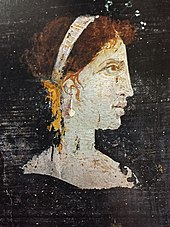

In various times and cultures, red hair has been prized, feared, and ridiculed.

Behavior about temperament
A mutual conventionalities about redheads is that they take fiery tempers and sharp tongues. In Anne of Green Gables, a character says of Anne Shirley, the redheaded heroine, that "her atmosphere matches her hair", while in The Catcher in the Rye, Holden Caulfield remarks that "People with red hair are supposed to get mad very hands, but Allie [his dead blood brother] never did, and he had very scarlet hair."
During the early stages of modern medicine, carmine pilus was thought to be a sign of a sanguine temperament.[71] In the Indian medicinal practice of Ayurveda, redheads are seen as most likely to have a Pitta temperament.
Another conventionalities is that redheads are highly sexed; for example, Jonathan Swift satirizes redhead stereotypes in part four of Gulliver's Travels, "A Voyage to the State of the Houyhnhnms," when he writes that: "Information technology is observed that the ruby-red-haired of both sexes are more libidinous and mischievous than the rest, whom nonetheless they much exceed in strength and activity." Swift goes on to write that "neither was the hair of this animate being [a Yahoo] of a crimson colour (which might have been some excuse for an appetite a little irregular) merely black as a sloe".[72] Such beliefs were given a veneer of scientific brownie in the 19th century past Cesare Lombroso and Guglielmo Ferrero. They concluded that crimson hair was associated with crimes of lust, and claimed that 48% of "criminal women" were redheads.[73]
Media, mode and art

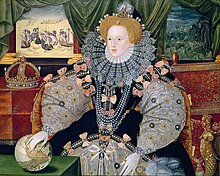
Queen Elizabeth I of England was a redhead, and during the Elizabethan era in England, scarlet hair was fashionable for women. In mod times, red hair is subject to mode trends; celebrities such every bit Nicole Kidman, Alyson Hannigan, Marcia Cross, Christina Hendricks, Emma Stone and Geri Halliwell can heave sales of crimson hair dye.[ citation needed ]
Sometimes, red hair darkens every bit people become older, becoming a more chocolate-brown color or losing some of its vividness. This leads some to associate red hair with youthfulness, a quality that is more often than not considered desirable. In several countries such as Republic of india, Iran, Bangladesh and Pakistan, henna and saffron are used on pilus to requite it a brilliant red appearance.[74]
Many painters have exhibited a fascination with red hair. The pilus color "Titian" takes its name from the artist Titian, who often painted women with red pilus. Early Renaissance creative person Sandro Botticelli's famous painting The Nascence of Venus depicts the mythological goddess Venus as a redhead. Other painters notable for their redheads include the Pre-Raphaelites, Edmund Leighton, Modigliani,[75] and Gustav Klimt.[76]
Sir Arthur Conan Doyle'south Sherlock Holmes story "The Reddish-Headed League" (1891) involves a man who is asked to go a member of a mysterious group of crimson-headed people. The 1943 film DuBarry Was a Lady featured red-heads Lucille Ball and Red Skelton in Technicolor.
Notable fictional characters with ruddy hair includes Jean Gray, Red Sonja, Mystique, and Toxicant Ivy.[77]
A book of photographs of cherry haired people was published in 2020, Gingers by Kieran Dodds (2020).[78]
Prejudice and discrimination confronting redheads
Medieval beliefs
Red hair was idea to be a marker of a beastly sexual want and moral degeneration. A roughshod red-haired man is portrayed in the legend by Grimm brothers (Der Eisenhans) every bit the spirit of the woods of atomic number 26. Theophilus Presbyter describes how the claret of a ruddy-haired immature human is necessary to create gold from copper, in a mixture with the ashes of a basilisk.[79]
Montague Summers, in his translation of the Malleus Maleficarum,[eighty] notes that red pilus and green eyes were thought to be the sign of a witch, a werewolf or a vampire during the Eye Ages;
Those whose hair is cerise, of a certain peculiar shade, are unmistakably vampires. It is significant that in ancient Arab republic of egypt, as Manetho tells us, homo sacrifices were offered at the grave of Osiris, and the victims were carmine-haired men who were burned, their ashes being scattered far and wide past winnowing-fans. It is held past some authorities that this was done to fertilize the fields and produce a bounteous harvest, cherry-red-hair symbolizing the aureate wealth of the corn. Merely these men were called Typhonians, and were representatives not of Osiris only of his evil rival Typhon, whose pilus was reddish.
Medieval antisemitism
During the Spanish Inquisition, people of cherry hair were identified as Jewish and isolated for persecution.[sixteen] In Medieval Italy and Spain, red pilus was associated with the heretical nature of Jews and their rejection of Jesus, and thus Judas Iscariot was commonly depicted as red-haired in Italian and Spanish art.[17] Writers from Shakespeare to Dickens would identify Jewish characters by giving them red hair, such as the villainous Jewish characters Shylock and Fagin.[81] The antisemitic association persisted into modern times in Soviet Russian federation.[18] The medieval prejudice against red-pilus may take derived from the Aboriginal biblical tradition, in relation to biblical figures such as Esau and King David. The Aboriginal historian Josephus would mistranslate the Hebrew Torah to describe the more positive figure of King David as 'golden haired', in contrast to the negative figure of Esau, even though the original Hebrew Torah implies that both Rex David and Esau had 'fiery red hair'.[82]
Modern-twenty-four hours discrimination
In his 1885 volume I Say No, Wilkie Collins wrote "The prejudice against habitual silence, among the lower gild of the people, is almost as inveterate equally the prejudice against cherry-red hair."
In his 1895 memoir and history The Gurneys of Earlham, Augustus John Cuthbert Hare described an incident of harassment: "The second son, John, was born in 1750. Every bit a boy he had vivid reddish hair, and it is amusingly recorded that one day in the streets of Norwich a number of boys followed him, pointing to his ruddy locks and saying, "Look at that boy; he'south got a bonfire on the top of his head," and that John Gurney was so disgusted that he went to a barber'south, had his head shaved, and went domicile in a wig. He grew up, however, a remarkably attractive-looking young homo."[83]
In British English, the discussion "ginger" is sometimes used to depict red-headed people (at times in an insulting manner),[84] with terms such as "gingerphobia"[85] and "gingerism"[86] used by the British media. In United kingdom of great britain and northern ireland, redheads are also sometimes referred to disparagingly equally "carrot tops" and "carrot heads". (The comedian "Carrot Height" uses this stage name.) "Gingerism" has been compared to racism, although this is widely disputed, and bodies such equally the UK Commission for Racial Equality do not monitor cases of discrimination and hate crimes against redheads.[86]
Nonetheless, individuals and families in United kingdom of great britain and northern ireland are targeted for harassment and violence considering of their hair color. In 2003, a 20-year-one-time was stabbed in the dorsum for "being ginger".[87] In 2007, a UK woman won an laurels from a tribunal after existence sexually harassed and receiving abuse because of her red hair;[88] in the same year, a family unit in Newcastle upon Tyne, was forced to move twice after being targeted for corruption and hate crime on account of their red pilus.[89] In May 2009, a schoolboy committed suicide after being bullied for having red pilus.[90] In 2013, a fourteen-year-erstwhile boy in Lincoln had his right arm cleaved and his head stamped on by three men who attacked him "just considering he had cherry-red hair". The iii men were afterwards jailed for a combined full of ten years and one calendar month for the attack.[91] A possible fringe theory explaining the historical and modern mistreatment of red-heads supposedly stems from Roman subjugation and consequent persecution of Celtic Nations when arriving in the British Isles.
This prejudice has been satirised on a number of TV shows. English comedian Catherine Tate (herself a redhead) appeared as a red-haired character in a running sketch of her series The Catherine Tate Show. The sketch saw fictional graphic symbol Sandra Kemp, who was forced to seek solace in a refuge for ginger people because she had been ostracised from guild.[92] The British comedy Bo' Selecta! (starring redhead Leigh Francis) featured a spoof documentary which involved a caricature of Mick Hucknall presenting a show in which celebrities (played by themselves) dyed their hair red for a day and went well-nigh daily life being insulted by people. (Hucknall, who says that he has repeatedly faced prejudice or been described as ugly on business relationship of his hair color, argues that Gingerism should be described as a form of racism.[93]) Comedian Tim Minchin, himself a redhead, also covered the topic in his song "Prejudice".[94]
The pejorative apply of the word "ginger" and related discrimination was used to illustrate a point well-nigh racism and prejudice in the "Ginger Kids", "Le Petit Tourette", "It's a Bailiwick of jersey Thing" and "Fatbeard" episodes of South Park.
Film and tv programmes oft portray school bullies every bit having cerise pilus.[95] However, children with red hair are frequently themselves targeted by bullies; "Somebody with ginger hair will stand out from the crowd," says anti-bullying skillful Louise Burfitt-Dons.[96]
In Australian slang, redheads are often nicknamed "Bluish" or "Bluey".[97] More recently, they accept been referred to as "rangas" (a word derived from the reddish-haired ape, the orangutan), sometimes with derogatory connotations.[98] The word "rufus" has been used in both Australian and British slang to refer to scarlet-headed people;[99] based on a variant of rufous, a ruby-red-dark-brown color.
In November 2008 social networking website Facebook received criticism afterward a 'Kick a Ginger' group, which aimed to establish a "National Kick a Ginger Day" on xx November, acquired almost 5,000 members. A fourteen-yr-old boy from Vancouver who ran the Facebook grouping was subjected to an investigation by the Royal Canadian Mounted Law for possible hate crimes.[100]
In December 2009 British supermarket chain Tesco withdrew a Christmas card which had the epitome of a kid with red hair sitting on the lap of Begetter Christmas, and the words: "Santa loves all kids. Even ginger ones" after customers complained the card was offensive.[101]
In October 2010, Harriet Harman, the former Equality Minister in the British government under Labour, faced accusations of prejudice after she described the reddish-haired Treasury secretary Danny Alexander as a "ginger rodent".[102] Alexander responded to the insult by stating that he was "proud to be ginger".[103] Harman was subsequently forced to apologise for the comment, after facing criticism for prejudice confronting a minority grouping.[104]
In September 2011, Cryos International, one of the world's largest sperm banks, announced that it would no longer take donations from red-haired men due to low demand from women seeking artificial insemination.[105]
Utilise of term in Singapore and Malaysia
The term ang mo (Chinese: 红毛; pinyin: hóng máo ; Pe̍h-ōe-jī: âng-mo͘ ) in Hokkien (Min Nan) Chinese, meaning "red-haired",[106] is used in Malaysia and Singapore, although it refers to all white people, never exclusively people with red hair. The epithet is sometimes rendered every bit ang mo kui ( 红毛鬼 ) meaning "crimson-haired devil", like to the Cantonese term gweilo ("strange devil"). Thus it is viewed equally racist and derogatory by some people.[107] Others, all the same, maintain information technology is adequate.[108] Despite this ambiguity, information technology is a widely used term. It appears, for instance, in Singaporean newspapers such as The Straits Times,[109] and in television programmes and films.
The Chinese characters for ang mo are the aforementioned equally those in the historical Japanese term Kōmō ( 紅毛 ), which was used during the Edo menses (1603–1868) as an epithet for Dutch or Northern European people. It primarily referred to Dutch traders who were the just Europeans allowed to trade with Japan during Sakoku, its 200-year period of isolation.[110]
The historic fortress Fort San Domingo in Tamsui, Taiwan was nicknamed ang mo sia (紅毛城).
The proper noun "Rory"
The mainly masculine given proper noun Rory – a name of Goidelic origin, which is an anglicisation of the Irish: Ruairí / Ruaidhrí/Ruaidhrígh/Raidhrígh, Scottish Gaelic: Ruairidh and Manx: Rauree [111] which is common to the Irish gaelic, Highland Scots and their diasporas[112] – ways "red-haired king", from ruadh ("cherry-haired" or "rusty") and rígh ("rex"). However, present bearers of the name are by no ways all cherry-haired themeselves.
Red hair festivals

Hundreds of redheads together at the Redhead Day, September 2007
There has been an almanac Redhead Day festival in kingdom of the netherlands that attracts red-haired participants from around the world. The festival was held in Breda, a metropolis in the south east of kingdom of the netherlands, prior to 2019, when it moved to Tilburg.[113] Information technology attracts participants from over lxxx countries. The international effect began in 2005, when Dutch painter Bart Rouwenhorst decided he wanted to paint 15 redheads.
The Irish Redhead Convention, held in belatedly August in County Cork since 2011, claims to be a global commemoration and attracts people from several continents. The celebrations include crowning the ginger King and Queen, competitions for the all-time ruddy eyebrows and almost freckles per square inch, orchestral concerts and carrot throwing competitions.[114]
A smaller cerise-hair day festival is held since 2013 by the United kingdom of great britain and northern ireland's anti bullying alliance in London, with the aim of instilling pride in having cherry-hair.[115]
Since 2014, a ruby-red-pilus event is held in State of israel, at Kibbutz Gezer (Carrot), held for the local Israeli red pilus community,[116] including both Ashkenazi and Mizrahi cherry-red-heads.[117] Withal, the number of attendees has to be restricted due to the risk of rocket attacks, leading to anger in the red-hair customs.[118] The organizers country; "The event is a good thing for many redheads, who had been embarrassed about being redheads before."[118]
The first and only festival for scarlet heads in the United States was launched in 2015. Held in Highwood, Illinois, Redhead Days draws participants from across the United States.[119]
A festival to celebrate the red-haired people is held annually in Izhevsk (Russia), the uppercase of Udmurtia, since 2004.[120]
MC1R Magazine is a publication for cerise-haired people worldwide, based in Hamburg, Federal republic of germany.[121]
Religious and mythological traditions

In ancient Egypt red pilus was associated with the deity Ready and Ramesses II had it.[122]
In the Iliad, Achilles' hair is described as ksanthēs ( ξανθῆς [123]), usually translated as blonde, or golden[124] but sometimes as ruby or tawny.[125] [126] His son Neoptolemus also bears the proper noun Pyrrhus, a possible reference to his own red pilus.[127]
The Norse god Thor is commonly described as having crimson hair.[128]
The Hebrew word usually translated "ruddy" or "ruby-red-dark-brown" (admoni אדמוני , from the root ADM אדם , come across likewise Adam and Edom)[129] [130] [131] was used to describe both Esau and David.
Early artistic representations of Mary Magdalene ordinarily draw her as having long flowing red hair, although a description of her hair color was never mentioned in the Bible, and information technology is possible the color is an result acquired by pigment deposition in the ancient paint.
Judas Iscariot is also represented with carmine hair in Spanish culture[132] [133] and in the works of William Shakespeare,[134] reinforcing the negative stereotype.
See also
- Black hair
- Blond
- Brown pilus
- Bigotry against people with ruby-red hair
- Erythrism – in non-homo animals
- How to exist a Redhead
- List of redheads
Notes
- ^ Defined in the study as the counties of Cumberland, Durham, Northumberland and Westmorland
References
- ^ "Hair Color". thetech.org. The Tech Museum of Innovation. 26 August 2004. Retrieved 14 January 2017.
When someone has both of their MC1R genes mutated, this conversion doesn't happen anymore and yous become a buildup of pheomelanin, which results in red hair
- ^ a b Valverde P, Healy E, Jackson I, Rees JL, Thody AJ (1995). "Variants of the melanocyte-stimulating hormone receptor factor are associated with red hair and fair skin in humans". Nature Genetics. 11 (3): 328–30. doi:10.1038/ng1195-328. PMID 7581459. S2CID 7980311.
- ^ "redhead, northward. and adj". OED Online. Oxford University Press. June 2011. Retrieved 7 Baronial 2011.
- ^ a b Moffat, Alistair (30 June 2017). "Celts' red hair could be attributed to the cloudy conditions". Irish Key . Retrieved 31 December 2014.
- ^ Moffat, Alistair; Wilson, James (1 May 2011). The Scots: A Genetic Journey. Birlinn. ISBN9780857900203 . Retrieved 6 June 2016.
- ^ Mcardle, Helen (26 April 2014). "Auld Reekie is earth capital letter for ginger hair". The Herald.
- ^ Cramb, Auslan (24 August 2013). "Edinburgh is surprise capital of redheaded Britain and Republic of ireland". The Telegraph. Archived from the original on 11 Jan 2022. Retrieved 21 Apr 2017.
- ^ Gray, John (1907). "Memoir on the Pigmentation Survey of Scotland". The Journal of the Royal Anthropological Institute of Peachy Great britain and Ireland. 37: 375–401. doi:10.2307/2843323. JSTOR 2843323.
- ^ Sunderland E (May 1956). "Pilus-color variation in the United Kingdom". Register of Human Genetics. 20 (4): 312–33. doi:10.1111/j.1469-1809.1955.tb01286.10. PMID 13314401. S2CID 31340197.
- ^ a b Consanguinity, Inbreeding, and Genetic Drift in Italian republic, Princeton University Press, 15 Feb 2013, Luigi Luca Cavalli-Sforza, Antonio Moroni, Gianna Zei, page 270
- ^ Fernández-Armesto, Felipe (1994). The Times guide to the peoples of Europe. London: Times Books. ISBN978-0-7230-0624-4.
- ^ Harvey, Jacky Colliss (ix June 2015). Red: A History of the Redhead. Hachette Books. ISBN9781603764032 – via Google Books.
- ^ Abel, Ernest L. (2001). Jewish genetic disorders: a layman's guide. Jefferson, N.C: McFarland. p. 229. ISBN978-0-7864-0941-nine.
- ^ Elkind. Evrei Trudi Antropologitshes-kavo Amdilla, xxi., Moscow, 1903
- ^ Maurice Fishberg (1911). Jews, race & environment. 99. Transaction Publishers. ISBN 978-1-4128-0574-2
- ^ a b The Jewish Persona in the European Imagination: A Case of Russian Literature, By Leonid Livak, (Stanford University Press 2010).
- ^ a b Judas's Cherry-red Hair and The Jews, Journal of Jewish Art (9), 31–46, 1982, Melinnkoff R.One thousand
- ^ a b Jewish hearts: a study of dynamic ethnicity in the United states of america and the Soviet Matrimony, SUNY Press, 2001, Betty N. Hoffman, page 106
- ^ Stirling, John (1870–1871). "The Races of Morocco". Periodical of the Anthropological Society of London. eight: clxix–clxxiii. doi:ten.2307/3025183. JSTOR 3025183.
- ^ Coon, Carleton Stevens (1939). "The Mediterranean World". The Races of Europe. New York: The Macmillan Company. pp. 480–482. OCLC 575541610. Retrieved 16 June 2013.
- ^ "Their pigmentation is characteristically brunet, but definite blonds occur. Black and dark dark-brown pilus run to 85 pct (85%) of the whole, while reds number 4 percentage (4%)", Carleton S. Coon, The Races of Europe (1939), Greenwood Press, 1972, p. 478
- ^ "There are, even so, a noticeable number of Kabyles with red hair, blue eyes and fair peel", Area Handbook for Algeria, American Academy, 1965, p. 91
- ^ Wahab, Shaista; Youngerman, Barry (2007). A Cursory History of Afghanistan. Infobase Publishing. ISBN978-1-4381-0819-3.
northeast of Kabul, however, the local population includes many people with blond or reddish hair and blue or ...
- ^ Studies, American University (Washington, D. C. ) Foreign Surface area; Smith, Harvey Henry (1969). Surface area Handbook for Afghanistan. U.S. Regime Press Office.
They are mostly of medium , slender physique , with dark , sometimes red , hair
- ^ Woog, Adam (2009). Mummies. Capstone.
- ^ Shishlina, North.; Pankova, Due south.; Sevastyanov, V.; Kuznetsova, O.; Demidenko, Yu. (2016). "Pastoralists and mobility in the Oglakhty cemetery of southern Siberia: new prove from stable isotopes". Antiquity. Cambridge. 90 (351): 679–694. doi:x.15184/aqy.2016.92.
- ^ Helfen-Maenchen, Otto, The Globe of the Huns: Studies of Their History and Civilization, pp.373. University of California Press ISBN 0520015967
- ^ Linghu, Defen. Book of Zhou, Volume l.
- ^ Rachel Lung (2011). Interpreters in Early Imperial Mainland china. John Benjamins Publishing Company. p. 108. ISBN978-9027224446 . Retrieved 15 June 2012.
- ^ Bretschneider, Emil (2000). Medieval Researches from Eastern Asiatic Sources. Psychology Press. p. 72. ISBN0415244862.
- ^ Hattaway, Paul (19 July 2018). Guizhou: The Precious Province. London: Club for Promoting Christian Knowledge(SPCK). ISBN978-0281079896. In appearance the Miao are pale yellowish in complexion, nigh white, their pilus is oftentimes lite or night brown, sometimes even ruby or corn-silk blond, and a few even have pale blue optics"- F.1000, Savina
- ^ Chao Romero, Robert; Ong, James; Guillermo-Wann, Chelsea; Logia, Jenifer (3 October 2019). Mixed Race Student Politics: A Rise "Third Wave" Motility at UCLA. Los Angeles, CA: UCLA Asian American Studies Centre. ISBN978-0934052528.
- ^ "How Did Saul Alvarez Become Canelo Alvarez? The Existent Reason Backside His Nickname". EssentiallySports. xiv December 2020. Retrieved 1 February 2022.
- ^ "Men make gods in their own image; those of the Ethiopians are black and snub-nosed, those of the Thracians accept bluish eyes and red hair." Xenophanes of Colophon: Fragments, Xenophanes, J. H. Lesher, Academy of Toronto Press, 2001, ISBN 0-8020-8508-3, p. 90.
- ^ Ridgeway, William (2014). The Early Age of Hellenic republic, Volume one. Cambridge University Press. p. 401. ISBN9781107434585.
- ^ Baumgarten, Siegmund Jakob; Beer, Ferdinand Wilhelm; Semler, Johann Salomo (1760). A Supplement to the English language Universal History: Lately Published in London: Containing ... Remarks and Annotations on the Universal History, Designed as an Improvement and Illustration of that Work ... East. Dilly. p. xxx.
- ^ "Mysterious Mummies of China". NOVA. Flavour 25. 20 January 1998.
- ^ "Periodical of the Polynesian Society: Front Matter P 1-vi". auckland.ac.nz.
- ^ "Archived copy" (PDF). Archived from the original (PDF) on 4 September 2011. Retrieved 12 June 2011.
{{cite web}}: CS1 maint: archived copy equally championship (link) - ^ Kenny, East, et al., "Melanesian Blond Pilus Is Acquired by an Amino Acid Alter in TYRP1", Science, 4 May 2012, Vol. 336 no. 6081 p. 554.
- ^ Box NF, Wyeth JR, et al. (Oct 1997). "Characterization of melanocyte stimulating hormone receptor variant alleles in twins with blood-red hair". Homo Molecular Genetics. 6 (11): 1891–97. doi:10.1093/hmg/6.xi.1891. PMID 9302268.
- ^ a b Harding, Rosalind M.; et al. (April 2000). "Show for Variable Selective Pressures at MC1R". American Periodical of Man Genetics. 66 (4): 1351–61. doi:10.1086/302863. PMC1288200. PMID 10733465.
- ^ "HGNC Symbol Report:HCL2". Factor.ucl.ac.uk . Retrieved nineteen August 2017.
- ^ H. Eiberg & J. Mohr (Baronial 1987). "Major locus for ruby hair colour linked to MNS blood groups on chromosome four". Clinical Genetics. 32 (2): 125–28. doi:10.1111/j.1399-0004.1987.tb03339.x. PMID 3477350. S2CID 28734686.
- ^ "Hair color gene study sheds new calorie-free on roots of redheads' locks".
- ^ Morgan, Michael D.; Pairo-Castineira, Erola; Rawlik, Konrad; Canela-Xandri, Oriol; Rees, Jonathan; Sims, David; Tenesa, Albert; Jackson, Ian J. (10 December 2018). "Genome-broad study of hair color in UK Biobank explains nearly of the SNP heritability". Nature Communications. 9 (i): 5271. doi:ten.1038/s41467-018-07691-z. ISSN 2041-1723.
- ^ Bodmer WF, Cavalli-Sforza LL.Genetics, development and human. San Francisco:WH Freeman; 1976.
- ^ "Nicole'south hair secrets". The Daily Telegraph. London. 2 October 2002. Archived from the original on 2 Feb 2007.
- ^ "Red hair genes 100,000 years old". Oxford Blueprint. 1 (eleven). 31 May 2001. Archived from the original on 9 July 2001.
- ^ Culotta, Elizabeth (26 October 2007). "Aboriginal Deoxyribonucleic acid Reveals Neandertals With Red Pilus, Off-white Complexions". Science. 318 (5850): 546–47. doi:10.1126/science.318.5850.546. PMID 17962526. S2CID 42196381.
- ^ Gingers extinct in 100 years. News.com.au. Retrieved 28 June 2009.
- ^ a b Redhead extinction. HowStuffWorks. Retrieved 28 June 2009.
- ^ Flanagan N, Healy Eastward, Ray A, et al. (Oct 2000). "Pleiotropic effects of the melanocortin one receptor (MC1R) gene on human pigmentation". Hum. Mol. Genet. 9 (17): 2531–seven. doi:10.1093/hmg/9.17.2531. PMID 11030758.
- ^ Rees JL (November 2004). "The genetics of sun sensitivity in humans". Am. J. Hum. Genet. 75 (5): 739–51. doi:10.1086/425285. PMC1182105. PMID 15372380.
- ^ Rees JL (2002a) Molecular phototypes. In: Ortonne J-P, Ballotti R (eds) Mechanisms of suntanning. Martin Dunitz, London, pp 333–339
- ^ Rees JL (2002b) Skin cancer (including nevoid basal cell carcinoma syndrome). In: Vogelstein B, Kinzler K (eds) The genetic footing of human cancer, 2nd ed. McGraw-Hill, New York, pp. 529–548
- ^ Liem EB, Joiner Telly, Tsueda K, Sessler DI (2005). "Increased sensitivity to thermal pain and reduced subcutaneous lidocaine efficacy in redheads". Anesthesiology. 102 (three): 509–fourteen. doi:10.1097/00000542-200503000-00006. PMC1692342. PMID 15731586.
- ^ Sullivan, Amy (11 December 2005). "Stoic Redheads". The New York Times . Retrieved 22 May 2010.
- ^ "Do redheads actually experience more hurting? The jury's withal out". Wellness Blog on TIME.com. 12 August 2009. Retrieved 22 May 2010.
- ^ a b Mogil JS, Ritchie J, Smith SB, et al. (July 2005). "Melanocortin-1 receptor cistron variants affect pain and mu-opioid analgesia in mice and humans". Journal of Medical Genetics. 42 (7): 583–7. doi:10.1136/jmg.2004.027698. PMC1736101. PMID 15994880.
- ^ Liem EB, Lin CM, Suleman MI, et al. (August 2004). "Anesthetic requirement is increased in redheads". Anesthesiology. 101 (2): 279–83. doi:ten.1097/00000542-200408000-00006. PMC1362956. PMID 15277908.
- ^ Mogil JS, Wilson SG, Chesler EJ, et al. (Apr 2003). "The melanocortin-1 receptor gene mediates female person-specific mechanisms of analgesia in mice and humans". Proceedings of the National Academy of Sciences of the United states of america of America. 100 (8): 4867–72. Bibcode:2003PNAS..100.4867M. doi:x.1073/pnas.0730053100. PMC153647. PMID 12663858.
- ^ Myles, P. S.; Buchanan, F. F.; Bain, C. R. (1 July 2012). "The Issue of Hair Colour on Anaesthetic Requirements and Recovery Time after Surgery". Anaesthesia and Intensive Care. forty (4): 683–689. doi:10.1177/0310057X1204000415. PMID 22813497.
- ^ a b Liem EB, Lin CM, Suleman MI, et al. (2004). "Anesthetic requirement is increased in redheads". Anesthesiology. 101 (two): 279–83. doi:10.1097/00000542-200408000-00006. PMC1362956. PMID 15277908.
- ^ Kumar VV, Kumar NV, Isaacson G (November 2004). "Superstition and postal service-tonsillectomy hemorrhage". The Laryngoscope. 114 (11): 2031–three. doi:10.1097/01.mlg.0000147942.82626.1c. PMID 15510037. S2CID 24987835.
- ^ a b Liem Edwin B, et al. (2006). "Women with Cherry Hair Study a Slightly Increased Rate of Bruising just Take Normal Coagulation Tests". Anesthesia & Analgesia. 102 (i): 313–318. doi:ten.1213/01.1.0000180769.51576.CD. PMC1351323. PMID 16368849.
- ^ a b Pathology Guy: Accumulations and Deposits Ed Friedlander, M.D., Pathologist. Last updated 24 September 2006
- ^ Challis BG, Pritchard LE, Creemers JW, et al. (Baronial 2002). "A missense mutation disrupting a dibasic prohormone processing site in pro-opiomelanocortin (POMC) increases susceptibility to early on-onset obesity through a novel molecular mechanism". Hum. Mol. Genet. eleven (17): 1997–2004. doi:ten.1093/hmg/11.17.1997. PMID 12165561.
Krude H, Biebermann H, Gruters A (June 2003). "Mutations in the homo proopiomelanocortin gene". Ann. Due north. Y. Acad. Sci. 994 (1): 233–nine. Bibcode:2003NYASA.994..233K. doi:ten.1111/j.1749-6632.2003.tb03185.x. PMID 12851321. S2CID 23462921. - ^ Walker, Susan; Higgs, Peter (2001), "Painting with a portrait of a adult female in profile", in Walker, Susan; Higgs, Peter (eds.), Cleopatra of Arab republic of egypt: from History to Myth, Princeton, N.J.: Princeton Academy Press (British Museum Press), pp. 314–315, ISBN9780691088358.
- ^ Fletcher, Joann (2008). Cleopatra the Great: The Adult female Behind the Fable. New York: Harper. ISBN 978-0-06-058558-7, image plates and captions between pp. 246-247.
- ^ The Applied Magnetic Healer G. One thousand. Brown 1899
- ^ Swift, Jonathan (1 February 1997). Gulliver'south Travels into Several Remote Nations of the World. Project Gutenberg. Retrieved 19 August 2017.
- ^ Nicole Hahn Rafter (ed), Lombroso & Ferraro, Criminal Adult female, the Prostitute, and the Normal Woman, Duke University Press, 2004, pp. 123–24.
- ^ Henna – history Plant Cultures: Exploring plants and people. 18 November 2004
- ^ "Epitome Young Redhead in an Evening Dress". WebMuseum. Retrieved 11 May 2011.
- ^ "Danae". WebMuseum. Retrieved 11 May 2011.
- ^ "Ane Ginger'south Top Ten List of Carmine Headed Superheroes (and Villains) - Women Write Almost Comics". womenwriteaboutcomics.com. 25 February 2014.
- ^ "In pictures: Connecting the world'due south redheads". BBC News. 15 November 2020.
- ^ Palo Galloni, Il sacro artefice, Laterza, Bari 1998 (Italian volume, chapter 2 most the recipe of Theophilus De auro hyspanico).
- ^ – see Malleus Maleficarum
- ^ Shakespeare and the Mediterranean: the selected proceedings of the International Shakespeare Clan World Congress, Valencia, 2001, Theatres and Performances, (Academy of Delaware Press, 2004), page forty
- ^ Interpretation of Scripture in Early on Judaism and Christianity: Studies in Linguistic communication and Tradition, Craig A. Evans, Bloomsbury Publishing, xiii Dec 2004, page 177-178
- ^ Hare, Augustus John Cuthbert (1895). ""The Dwelling of Earlham"". The Gurneys of Earlham.
- ^ "Redheads We Love!". The Huffington Mail service. 29 June 2012. Retrieved 5 July 2012.
- ^ Gingerphobia: Carrot-tops run across red BBC News, 22 February 2000
- ^ a b BBC News (half-dozen June 2007). "Is Gingerism as Bad as Racism?". Retrieved five July 2007.
- ^ BBC News (24 November 2003). "Man stabbed over "ginger hair"". Retrieved 5 July 2007.
- ^ "Woman wins ginger jibes tribunal". BBC News. 25 June 2007. Retrieved 21 April 2017.
- ^ Red-haired family unit forced to move BBC News, 2 June 2007
- ^ Schoolboy bullied over ginger pilus hanged himself Daily Telegraph, 12 May 2009
- ^ "'Cerise hair revenge' attack on Lincoln boy sees men jailed". BBC News. 16 April 2013. Retrieved 11 November 2013.
- ^ Catherine Tate: Ginger Refuge video Gingerism.com, 18 December 2008
- ^ Jinman, Richard (four July 2003). "Taking the Mick". The Sydney Morning Herald . Retrieved 21 April 2017.
- ^ Tim Minchin (4 March 2010). "Prejudice by Tim Minchin". YouTube. Archived from the original on 30 October 2021. Retrieved 19 August 2017.
- ^ Daily Bruin (three April 2006). "The stigma of Television receiver's redheads". Retrieved 24 June 2015.
- ^ "Carrot-Tops: Beingness Cerise Not So Easy". ABC News. 13 August 2007. Retrieved 29 August 2013.
- ^ "Australian slang – a story of Australian English". Australia.gov.au. Archived from the original on 19 August 2017. Retrieved nineteen August 2017.
- ^ "Word of the calendar month" (PDF). Oxford Commonwealth of australia Word of the Month. Oxford University Printing. Nov 2012. Archived from the original (PDF) on 14 Feb 2017.
- ^ "Rufus River". Geographical Names Register (GNR) of NSW. Geographical Names Board of New South Wales. Retrieved 10 February 2013.
- ^ Moore, Matthew (22 November 2008). "Facebook 'Kick a Ginger' campaign prompts attacks on redheads". The Daily Telegraph. London. Archived from the original on 11 January 2022. Retrieved 28 December 2009.
- ^ "Tesco apologises over 'ginger jibe' bill of fare". BBC News. 14 December 2009. Retrieved 28 December 2009.
- ^ Milton, Nicholas (10 May 2016). "I likewise have ginger hair. Abusing us is not acceptable prejudice". The Guardian . Retrieved 21 April 2017.
- ^ "Harriet Harman says 'ginger rodent' comment was wrong". BBC News. 30 October 2010.
- ^ Moss, Vincent (31 Oct 2010). "Harriet Harman apologises for 'ginger rodent' jibe at Danny Alexander". Daily Mirror. London.
- ^ "Sperm bank can't find takers for cherry-red-haired genes". The Star. Toronto. twenty September 2011.
- ^ Walter Henry Medhurst (1832). "A Dictionary of the Hok-Këèn Dialect of the Chinese Language, according to the Reading and Colloquial Idioms; containing well-nigh 12,000 Characters … Accompanied past a Brusk Historical and Statistical Account of Hok-Këèn; a Treatise on the Orthography of the … Dialect, etc". Macao: Printed at the Honorable E India Visitor's Press by Thou.J. Steyn and Brother: 481, col. ane.
紅毛 âng mô, red haired, generally practical to the English language people.
- ^ See, for instance, g Soh Chin (30 October 2004). "Soh Chin". The Straits Times (Life!). Singapore. p. 4.
[M]any of my Singaporean friends felt the term 'ang moh' was definitely racist. Said one, with surprising finality: 'The original term was "ang moh gui" which means "red hair devil" in Hokkien. That'south definitely racist.' Even so, the 'gui' bit has long been dropped from the term, defanging it considerably. … Both 'ang moh gui' and 'gwailo' – Cantonese for 'ghost (white) guy' – originated from the initial Chinese suspicion of foreigners way dorsum in those days when the country saw itself every bit the Middle Kingdom.
; Ashley, Sean (5 November 2004). "Stop calling me ang moh [letter]". The Straits Times. Singapore. p. v.As an 'ang moh' who has lived hither for over six years, I hope more people will realise simply how offensive the term is.
- ^ For instance, Hubble, Garry (v November 2004). "ang moh". The Straits Times. Singapore. p. 5.
To have my Chinese Singaporean friends call me 'ang moh' is more than humorous than anything else. Every bit no insult is intended, none is taken.
- ^ Sargent, Michael D. (21 October 2007). "Lessons for this gweilo and ang moh". The Straits Times. Singapore. Archived from the original on 25 March 2014. ; Ee Wen Wei, Jamie (11 November 2007). "Encounter Bukit Panjang's 'ang moh leader'". The Straits Times. Singapore. Archived from the original on xv May 2007.
- ^ See, for instance, Ranzaburo Otori (1964). "The Acceptance of Western Medicine in Nihon". Monumenta Nipponica. xix (3/4): 254–274. doi:x.2307/2383172. JSTOR 2383172. ; P[eng] Y[oke] Ho; F. P[eter] Lisowski (1993). "A Brief History of Medicine in Nihon". Concepts of Chinese Science and Traditional Healing Arts: A Historical Review. Singapore: World Scientific. pp. 65–78 at 73. ISBN978-981-02-1495-i. (hbk.).
The civilization which entered Nihon through the Dutch language was chosen Kōmō culture – Kōmō means red hair.
; Winkel, Margarita (1999). "Academic Traditions, Urban Dynamics and Colonial Threat: The Rise of Ethnography in Early Mod Japan". In van Bremen, Jan; Akitoshi Shimizu (eds.). Anthropology and Colonialism in Asia and Oceania. Richmond, Surrey: Curzon. pp. 40–64 at 53. ISBN978-0-7007-0604-4.His [Morishima Chūryō'due south] volume on the Dutch, 'Red-hair miscellany' (Kōmō zatsuwa), also appeared in 1787. … 'Scarlet-pilus miscellany' is the first volume which contains a relatively all-encompassing clarification of the daily life of the Dutch residents in the confinements of Deshima, the human being made island allotted to them in the Bay of Nagasaki.
; Veldman, January E. (2002). "A Historical Vignette: Blood-red-Hair Medicine". ORL. 64 (2): 157–165. doi:10.1159/000057797. PMID 12021510. S2CID 7541789. ; Thomas M. van Gulik; Yuji Nimura (January 2005). "Dutch Surgery in Japan". World Journal of Surgery. 29 (1): 10–17 at x. doi:10.1007/s00268-004-7549-3. PMID 15599736. S2CID 25659653.Several Dutch surgical schools were founded through which Dutch surgery, known in Japan as 'surgery of the ruddy-haired' was propagated.
; Michael Dunn (twenty Nov 2008). "Japanning for southern barbarians: Some of the first items traded with the Westward were busy with maki-e lacquer". Japan Times. Archived from the original on 24 June 2010.Dutch taste dictated a new fashion of consign lacquer known every bit 'komo shikki' ('red hair' – a mutual term for Northern Europeans), in which elaborate gold-lacquer decoration replaced the complex inlays of Nanban ware.
- ^ Martin-Doyle, Katie (1999). Treasury of Baby Names. Cambridge: Worth Press. p. 220. ISBN978-1-903025-xi-six.
Anglicised form of the Irish Gaelic names Ruaidhri, Ruari, and the Scottish Gaelic Ruairidh and Ruaraidh
- ^ Hanks, Patrick; Hodges, Flavia (1996). Larn about the family history of your surname. ISBN0-nineteen-280050-7. for the given proper noun "Rory".
- ^ Spencer, Clare (9 September 2009). "People get red-dy". BBC News Mag. BBC. Retrieved x September 2009.
- ^ Curtis, Dan (25 August 2014). "The Irish Redhead Convention takes identify in County Cork". BBC News . Retrieved four September 2014.
- ^ Mulroy, Zahra (2 July 2015). "Ginger Pride festival will be held in 2016 to celebrate redheads". Mirror.co.u.k. . Retrieved nineteen August 2017.
- ^ "Israel holds first conference for 'gingers'". Al-monitor.com. 29 August 2014. Archived from the original on xix August 2017. Retrieved nineteen August 2017.
- ^ Fifty shades of orangish: A conference on Kibbutz Gezer redheads Past Hagai Matar, Mekomit.co.il, 28 August 2014.
- ^ a b Finally, a Red Alert This Summer That (Most) Israelis Welcomed Roy Arad, Haaretz.com, xxx August 2014.
- ^ Mlinaric, Jessica. "Photos: We Visited The Merely Festival For Redheads In The U.S." Chicagoist. Archived from the original on 25 Oct 2016.
- ^ "Рыжий фестиваль". izh.ru (in Russian). Izhevsk city portal. 2017.
- ^ "MC1R Mag". mc1r-magazine.com.
- ^ Brier, Egyptian Mummies (1994), pp. 200–01.
- ^ "Homer, Iliad, Volume 1". Perseus Digital Library. Tufts Academy. Retrieved 2 May 2011.
- ^ Homer (1999). The Iliad. Trans. Ian Johnston, Ian C. Johnston. Penguin. p. 210. ISBN978-0-9776269-0-viii . Retrieved 1 May 2011.
As he argued in his mind and centre, he slid his huge sword office way from its sheath. At that moment, Athena came down from heaven. White-armed Hera sent her. She cherished both men, cared for them every bit. Athena stood behind Achilles, grabbed him by his golden hair, invisible to all except Achilles.
- ^ Homer (1999). The Iliad: the story of Achillês. Trans. William Henry Denham Rouse. Penguin. pp. 14–15. ISBN978-0-451-52737-0 . Retrieved 1 May 2011.
Equally these thoughts went through his heed, and he began to describe the great sword from the sheath, Athena came downward from heaven: Queen Hera sent her, loving and broken-hearted at one time. She stood backside him and held him back by his long red hair. No other human saw her but Achilles alone.
- ^ Homer (1999). Iliad: Books 1–12. Trans. Augustus Taber Murray, William F. Wyatt. Harvard University Press. p. 27. ISBN978-0-674-99579-six . Retrieved 1 May 2011.
- ^ Grant, Michael; Hazel, John (2002). Who's who in classical mythology. Psychology Press. p. 359. ISBN978-0-415-26041-i . Retrieved 1 May 2011.
The kid later on born to her was chosen Pyrrhus ('carmine-haired'), either because he had red hair or because the disguised Achilles had been known at Lycomedes' court as Pyrrha.
- ^ Lacy, Terry Chiliad. (2000). Band of Seasons: Republic of iceland—Its Culture and History. University of Michigan Press. p. 85. ISBN978-0-472-08661-0 . Retrieved one May 2011.
He had a mass of ruddy pilus and a red beard and, when roused, a fearsome voice and a penetrating gaze under beetling cherry eyebrows.
- ^ "Strong's Exhaustive Concordance of the Bible". Abibleconcordance.com . Retrieved 19 Baronial 2017.
- ^ "Biblos Potent's Exhaustive Concordance of the Bible". Biblesuite.com . Retrieved 19 August 2017.
- ^ "Biblos Strong's Exhaustive Cyclopedia of the Bible". Biblesuite.com . Retrieved 19 Baronial 2017.
- ^ Red Hair. The eclectic magazine of strange literature, scientific discipline, and art. Vol. two. Leavitt, Trow, & Co. July 1851. pp. 315–317.
- ^ White, Joseph Blanco (1825). Letters from Espana. H. Colburn. p. 256.
- ^ Nares, Robert; Halliwell-Phillipps, James Orchard; Wright, Thomas (1859). A glossary: or, Drove of words, phrases, names, and allusions to customs, proverbs, etc., which have been idea to crave illustration, in the words of English authors, particularly Shakespeare, and his contemporaries. Vol. 1. J.R. Smith. p. 473.

Further reading
- Cass, Cort (2003). The Redhead Handbook. Blue Mount Arts, Inc. ISBN978-1-58786-011-9.
External links
 | Wikimedia Commons has media related to Red hair. |
 | Look up redhead in Wiktionary, the gratuitous dictionary. |
Source: https://en.wikipedia.org/wiki/Red_hair
Posted by: morrisboally.blogspot.com
0 Response to "What Is The Genetic Makeup Of The Irish"
Post a Comment