

How To Draw People In A Car
Creating drawing versions of real-life objects can allow people to do the craziest things with possibly the nearly basic designs, while exploring their inventiveness to no end! Cars are no exception to this way of working, and many zany ideas have been concocted over the years. In this tutorial I volition testify you how to create a simple cartoon motorcar, and then you too tin can create your own twisted rendition of your favourite auto!
i. Fix Upwards Your Certificate
Firstly, in Photoshop click New, then under the Canvas Size option curlicue down the options until you lot are nether the International Size heading, and select size A3 canvas.
Secondly, bank check the resolution of your prototype, which you lot will find displayed in the setup box. For this document I would recommend a resolution of 300 dpi or college, as this level is a standard print format setup. Of course, if you wish to get into greater detail you can set the resolution higher.
Take note, if you have already created the certificate by accident, you tin can become to the View selection on the job bar, curl down and select the Sail Size option. In the dialog box that should appear, you can then modify the resolution of your canvass this way. Once you have these parameters set up, click on the OK button and we are ready to become!


two. Warm Up
Now that we accept our canvass prepare, we shall begin with a few simple sketches to get an idea of where we want to go. To begin our sketches, take a uncomplicated Round Castor at a size between 10 and fifteen and and so movement across to your canvas.
In this tutorial we are going to be drawing a sports car, which can be constructed using simple rectangles and long, sweeping lines. If y'all are non accustomed to drawing sweeping lines, practise in a dissever document using your graphics tablet and pen, making long strokes on the sheet and experimenting with different types of pen pressure.


3. Plant Perspective
Stride i
Nosotros should now be warmed upwardly and ready to go on with our sketch. At this indicate we need to plan our sketch and piece of work out our perspectives. We begin constructing our vehicle by drawing a simple foursquare and and so building this upwards into a box that will class a base for the body of our car. To draw our square in the proper perspective, you kickoff take the Line Too l (U)and then draw a basic horizontal line across the canvas most two thirds of the fashion upward the page, which will act equally our horizon.


Pace 2
For this cartoon we will be using a three-point perspective setup which, as the name suggests, is basically iii so-called vanishing points just off the canvas that will help us with our perspective and which our relevant guidelines will be fatigued toward. To begin with, we shall focus on the point just off to the left of the image. As with the horizon line, take the Line Tool and draw a directly line across the folio from where your vanishing point is.


Step iii
Now nosotros motility to the other vanishing points. As above, take the Line Tool and draw a line from the vanishing betoken on the correct side. Nosotros should now have a basic thought of where the rest of our lines are going to go.


Step four
We now need to depict additional lines that will form our box. At this point too it may be worth your while cartoon in additional lines that might aid with the perspective of other machine components, e.g. wheels, grille and windows. We now await at the 3rd vanishing signal, which is a distance above the image and, as with the concluding ii steps, draw a tertiary line that goes from this 3rd point and downwardly through the canvas. If you wish to do so, y'all can draw in some direct lines that establish the parameters of the box.


4. Create a Simple Sketch
Step 1
Now that the perspective is established, we can become busy with our sketch. Begin by creating a New Layer over the top of our perspective layer. And then reduce the Opacity of the original perspective layer to 50%. In one case this is done, we at present draw a unproblematic box that volition course the lower trunk of the car.


Step 2
Next, draw a second box that will make up the driving area of the vehicle. If your perspective has been set up correctly, you lot should not exist having whatsoever issues at this point.


Footstep 3
Now we outset moving on to more complex lines and shapes and, if you followed the warm-up steps earlier, you shouldn't accept many issues. At this indicate nosotros shall describe in the wheel arches on the motorcar and, as mentioned previously, sweeping lines are a must with drawing these.


Step 4
Next we move on to cartoon in some lines marking out the edges of the bonnet and doors of the car. I find drawing these in at an early stage helps later when it comes to the effectively details.


Pace 5
Nosotros now add the bones shapes that volition ascertain the lights and grille on the vehicle. Over again, at this stage, being refined in your cartoon is not necessary.
Information technology will exist worth your while flipping your canvas to bank check whether all of your perspectives add up. What this entails is basically flipping your sail through 180 degrees so that it looks as if you are looking at it through the dorsum.
To do this, first get to the Image > Rotate Sail option, and so click on Flip Sheet Horizontal. If yous see whatever mistakes, utilise the Eraser Tool in the toolbar or the eraser on your tablet pen if you have i and remove whatsoever error, and then redraw whatever lines correctly. To flip your canvas dorsum, repeat the above process.


5. Refine Your Sketch
Step one
At present that we accept a completed loose sketch on our canvas, nosotros shall brainstorm to refine it and make it look more similar an actual auto rather than simply a brew of lines.
Now that nosotros have our base sketch, we are going to go over it once again to make clean up whatever loose lines and fix whatever issues with perspective and proportion. Equally in the previous department, our first order is to create a New Layer on tiptop of our electric current sketch and reduce the Op acity of the underlying layer to thirty%.


Step 2
On the new layer you have created, take your circular brush and trace over the top of the original layer, taking a lot more than care with your castor strokes as you lot go. Eventually, you should at present have a clean sketch to motion forward to the inking phase.


half dozen. Ink Your Sketch
Step 1
We now motility on to creating our clean line piece of work that we will have forward to our colouring stage. Every bit previously, our first step is to create a New Layer over the top of the sketch layer and reduce the Opacity of this to l%. In one case you have done this, be sure to Lock the sketch layer to prevent you drawing on that layer by mistake.


Pace 2
Now for the inking phase, for which we need a make clean solid brush, and the merely way to get this is past making some adjustments to the settings of the brush in the Brush Settings window. In this window are listed the Sh ape Dynamics, Transfer, Spacing, Airbrush and Smoothing options, and these control the fluidity, hardness and overall look of your lines.
Personally, I prefer to accept a standard circular brush and then, when you look at its settings, y'all uncheck the Tra nsfer and Airbrush boxes. In the Southward hape Dynamics y'all desire to turn the Grand inimum Bore downward to 0%. Leave all other settings, including the Due south moothing box and the Due south pacing settings, as they are. They do not need changing for what nosotros are about to do.


Stride 3
Now that we take our tools set up, we shall motility on to the inking. Start past zooming your epitome in on a measured department of the machine. It doesn't matter if you begin on the left or right side of the canvas as this is a digital film and, different pencilled drawings, yous will not smudge work when moving across the image! Brainstorm drawing a fine line over your refined sketch, taking great care as you work. You will discover it best to work in small sections, working your fashion around the image equally you become.


Step 4
As you work, keep a mental notation of where your calorie-free source/s are coming from. The reason for this is that areas of shadow are oftentimes divers past thicker lines and in areas of highlights a thinner line is normally used, a principle that we shall be adopting to create this image.


Step five
Continue inking the auto section by section, and for more fine details remember to adapt your B rush Size in the setting box forth the pinnacle bar. Eventually yous should have a completely inked car body.


Step vi
For a quick and easy way of making the wheels of the auto, create a N ew Layer and select the E lliptical Marquee Tool. Simply describe an ellipse that is roughly the same height as the ellipse we take sketched, and then use the F ill Tool to fill the ellipse with plain black color. The O pacity of the layer then needs to be reduced to fifty%.


Step seven
Now, get across to the E dit > T ransform > Due south kew choice.


Stride 8
From here you can pull each of the corners and distort your ellipse to lucifer the sketch below. When it is right, click once and select the A pply option in the pop-up window.


Stride 9
With the ellipse withal selected, get toS elect > M odify and and so across to the Contract option. In the popular up box that follows this, contract the pick by between 25 and 30 Pixels and so click Contract.


Stride x
Finally, become to Edit > C ut, or every bit a shortcut agree downwards the Commandand 10 buttons. You should now have a complete outer wheel.


Step 11
Now follow the same process for the rear wheel and the bike on the right of the car.


Stride 12
The next step is to create the inner rims, following the same principle as we used to create the outer rims.


Stride 13
For the spokes of the machine's wheels, return to the apply of our pen and conscientious inking technique. As with other detailed parts, spend as much time as you can on this, as the wheels will provide a major focal signal of this epitome and viewers will spot whatever mistakes.
Finally, if there are any major blackness areas that do not have any colour in them, make full these in with black colour.


7. Color Your Prototype
Step ane
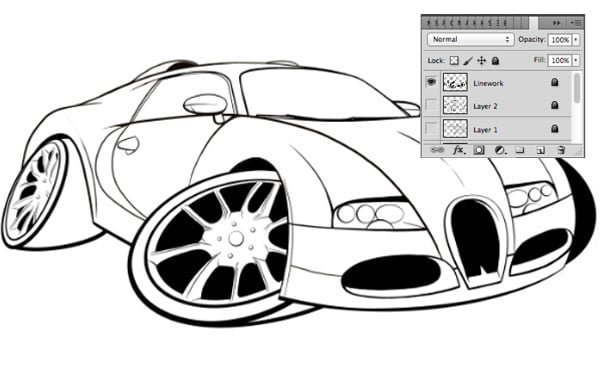
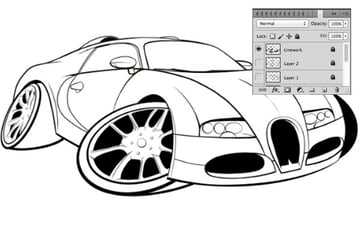
We should at present have produced a make clean inked paradigm that is ready to color. To assist u.s.a. later along the manner, double-click on this layer and you will at present detect you are able to alter the proper name of this layer. Nosotros are going to alter this name to "line piece of work".
As a result of doing this, we can now tell hands what this layer is amongst the others. It is worthwhile L ocking this layer then that we do not make any mistakes after on. Also think to create a N ew Layer for our colour work.
Footstep ii
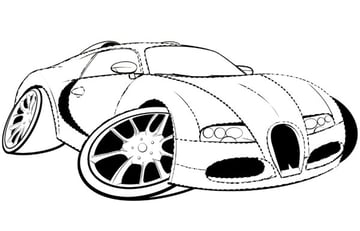
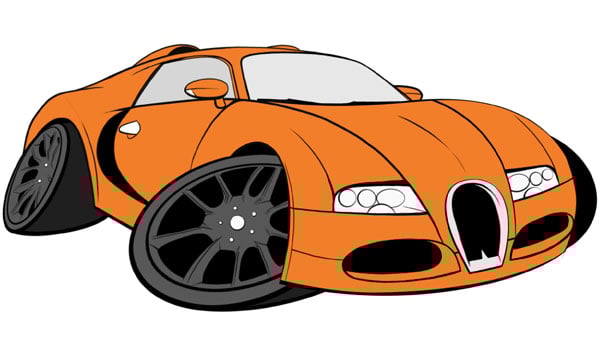
At this phase, the all-time way to go about colouring an prototype is to begin laying down a flat base of operations colour that has no gradient in information technology whatsoever. It is later we will showtime adding our shadows and highlights. To start with, we shall add together a base tone for the body as it is the largest expanse of the motorcar, and we are going to practise this in orange.
To select this area nosotros are going to accept the Chiliad agic Wand Tool and click on areas of the car body that nosotros wish to fill with color. To brand multiple selections with the M agic Wand Tool hold down the Shift key equally yous select areas. To de-select areas that you practice non want coloured, hold down the Alt key every bit you click the area. To finalise your selection, go to the Due south elect > M odify > E xpand pick and then aggrandize the selection by iv pixels. This last little task volition make sure the image volition be filled with colour and you volition not exist left with any unsightly white highlights.

Footstep 3
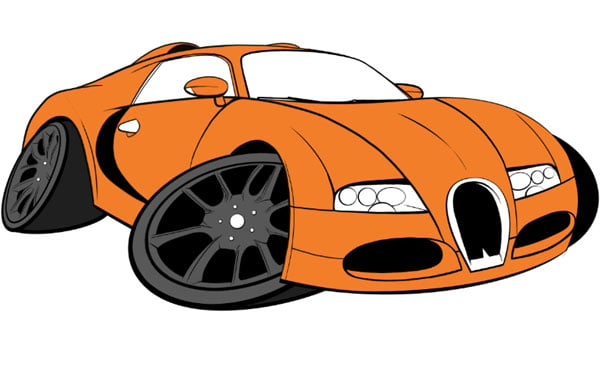
Now fill up this selection with a flat orangish colour and, one time done, d e-select your pick by simply clicking off the selection using either the Ellipse Toolor the Lasso Tool.


Step 4
We now move on to the wheels, which we are going to paint a gun-metal grey color, as I think it goes well with the orange trunk colour scheme. To select these, follow the same principle as outlined in footstep 2 and so fill up your pick with grey tone.

Pace v
Moving on to the windows, we will be using a lighter grey tone than the wheels, so make full these in using the same method as in the previous step. For the lights, utilize a very light greyness tone. Now we should have a flat base for our machine, and we can now brainstorm to build up the details.

8. Add Shadows, Highlights and Effects
Step one
Earlier we proceed with our highlights, here is a useful tip for creating a convincing paint await, as many modernistic sports cars take metal paint finishes and we can create this effect in Photoshop with relative ease.
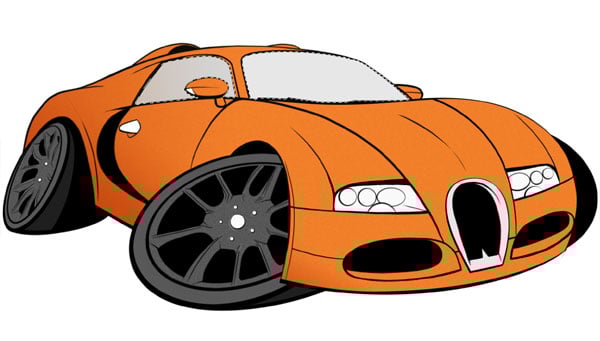
Starting time, D uplicate the base layer by going across the top bar of our workspace to the L ayer button and and so downward to Duplicate Layer. With our duplicate layer nosotros go across to the Select button and down to Filter and then across to Add Racket. From here a popular-up box will appear, and in this yous will come across A mount with a default percentage within it, and all y'all need to do is adjust this to 9.51%. It does not sound much, only this will be plenty to give u.s. the paint "bit" we are later.


Pace 2
Adjacent, on this indistinguishable layer, we are going to remove the sections of the windows, tyres and lights, as these areas do non need our metallic "fleck" issue. To do this, go dorsum to our original layer and select the windows and lights using the Grand agic Wand Tool, and so return to our D uplicate Layer and cut the areas we have selected.
Step 3
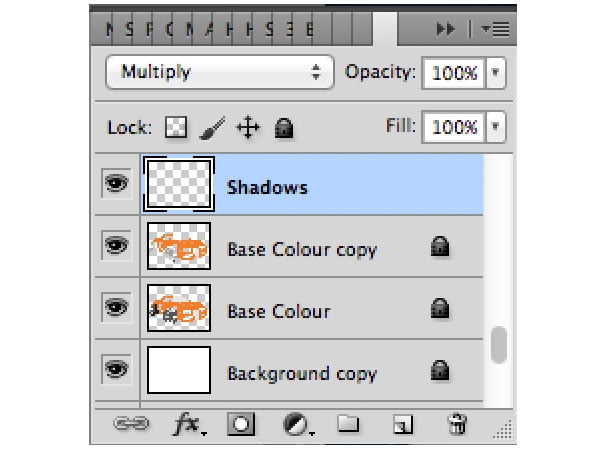
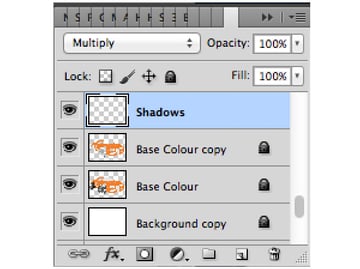
When creating a digital moving picture, I find it best to work on your shadows first. On superlative of our base of operations layers (both the original and our duplicate), create a Due north ew Layer and in the L ayer Settings box adjust this from Normal to Multiply. It would be good practise likewise to proper noun this layer "S hadows" so we tin can proceed track of our layer hierarchy.
Stride 4
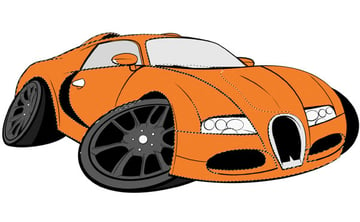
Now click on our base colour layer and select the machine's orangish bodywork. Then have the 50 asso Tool and, in the F eather box across the top bar, adjust the pixel plumage to xx px. Then hold downwardly the Alt key and carefully de-select the areas we do not want to take in shadow.

Pace 5
At present nosotros have our shadow area selected and prepare to exist filled. To practise this, we now select the G radient Tool in the toolbar, and before you make full your selected area make sure you take the O pacity Level across the top bar set to 50%.
Once this is done, click and drag your mouse a measured altitude across the page and so release, which should give you lot a nice fill up of colour in your selected area. Have annotation, if you lot do not like the way your colour make full comes out the get-go time, utilise the U ndo choice (Command-Z) to become back on what you have washed.


Stride half-dozen
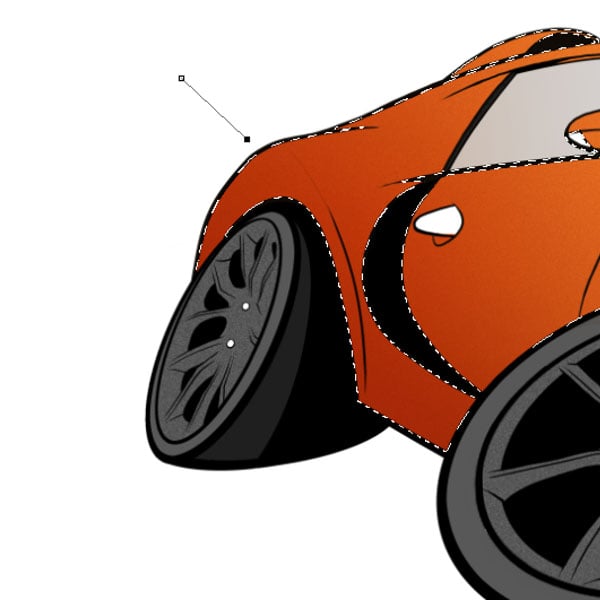
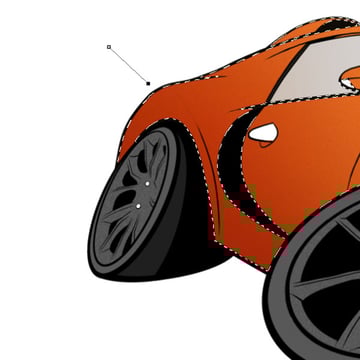
For harder shadows, create a Northward ew Layer, making sure this layer too is gear up to Multiply, and follow the same option method as for the other shadows above. Once selected, take the P en Tool, which works a picayune like the L asso Tool but gives y'all more control, which is exactly what you demand for this step.
First click outside of the selection and you will meet a point appear—this marks the first of your P ath, which is basically a more controlled method of choice. To further your pick, motility your arrow across and click once again to create another indicate of your path.
Footstep 7
You volition find, however, that with this selection routine you can but create straight lines. To create a curve in your path (and for this it is best do to employ a mouse), you need to first click to make a starting bespeak in your path, then motility your mouse to another point on the canvas and click again, just this fourth dimension as you click keep the mouse push held downward. And so drag your mouse button across and around, and you will notice that you get a curve forming instead of a directly line.
How much of a curve you want is upwardly to you, but ideally nosotros want a path that has a overnice fluid curve. Go on doing this if you need to make any more selections of this blazon.

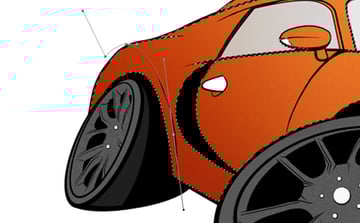
Stride 8
When nosotros become to the stop of our selection, correct-click and go downwards to M ake Selection, and you will see a pop-upwardly window announced. Click the Northward ew Selection option and you will now notice we take a selected area. If you accept made the right selections, this expanse should have all the sharp lines nosotros need for more detailed shadows.

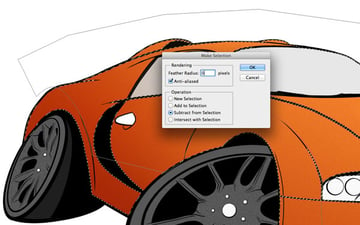
Step 9
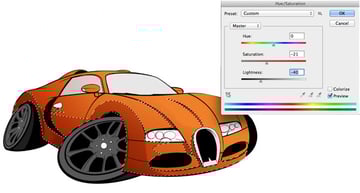
Now fill this surface area with some other orange tone. If the colour is not dark enough for you, get beyond the top bar to I mage > A djustments > H ue/Saturation. From this selection a popular-up box volition announced and you will be faced with three sliders: Hue, Saturation and Lightness. For shadows, I personally would go out the H ue level for now and concentrate only on the S aturation and Lightness levels. For this function of the project I would adjust the S aturation to between -20 and -40 and reduce the L ightness to -ten. Click the OK button to confirm, and so de-select.
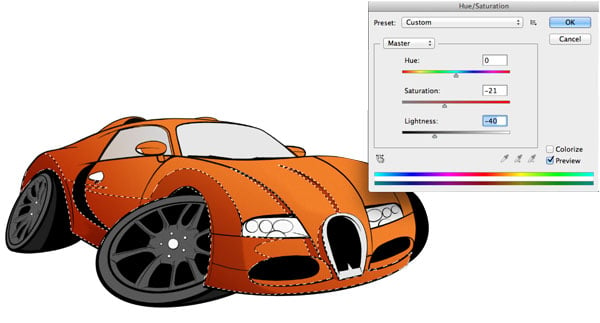
Pace 10
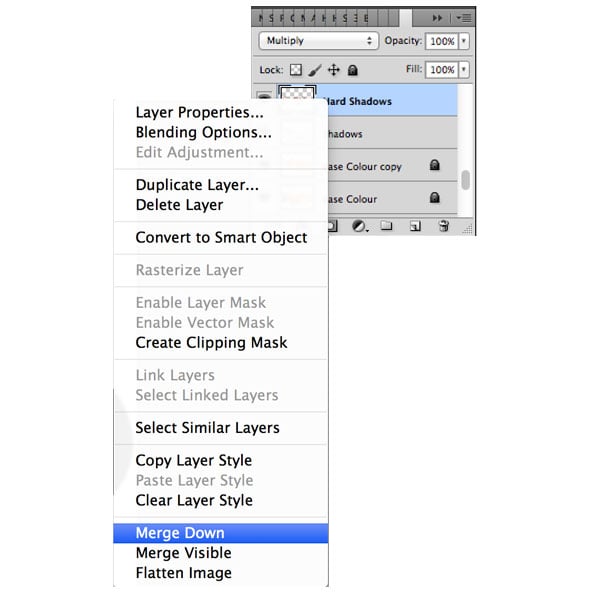
We now demand to K erge the layers.

Stride 11
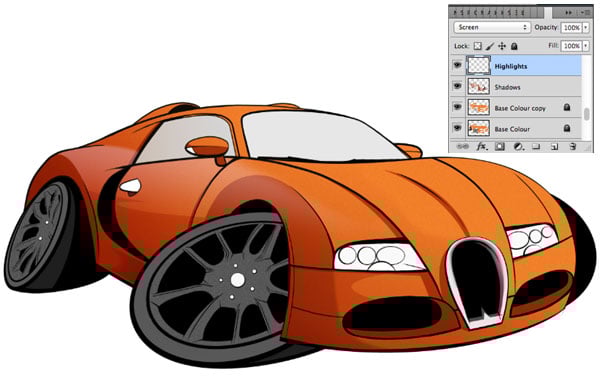
Now that we have our shade established, nosotros shall move on to our highlights. As with our shadows, nosotros brainstorm by creating another N ew Layer on pinnacle of our existing "multiply" layers. However, this time nosotros shall alter our settings to Screen rather than multiply. This basically means that any tones nosotros now put into our selected areas will be lighter than our standard base layer.
Step 12
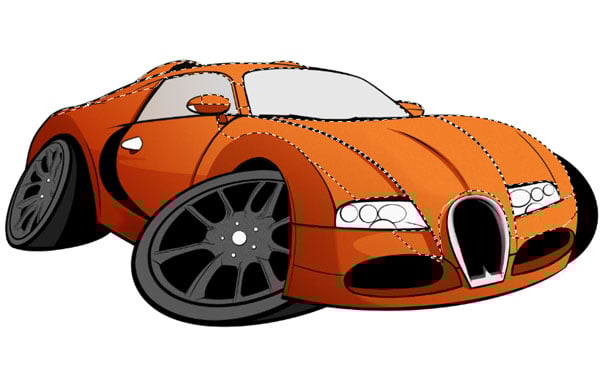
Every bit in our shadow steps previously, select the body of the car with the M agic Wand Tool, so take our L asso Tool and adjust the F eather option to between 20 and 35 px. Then de-select areas of the torso until yous accept a choice expanse as in the screenshot below.

Step 13
Now add an orange colour that is slightly lighter than our base colour, using the G radient Tool. I find information technology best to drag our Gradient Tool from the right to the left of the canvas.

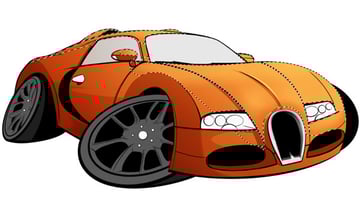
Footstep 14
It might assistance our epitome if we have some cogitating highlights too. I would recommend that these are in a mid-blue colour on another N ew Layer and ensure, as on other layers, this is set to "screen". So, as to a higher place, utilise the K radient Tool,simply this fourth dimension drag your mouse from left to right. Additional highlight layers may be needed to create the right event, but eventually you should exist left with an image that looks like the screenshot below.

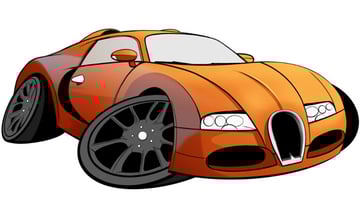
Step fifteen
Use your L asso Tool to marking out a choice on our R eflective Highlight layer that gives the impression of objects opposite the auto reflecting on the bodywork of the car. In one case you've fatigued it out, C ut out your selection. If you are left with a selection like in the screenshot below, you are on the right track. Besides make sure you have Thou erged your layers to go on the hierarchy under control.


ix. Work on the Wheels, Interior and Lights
Step 1
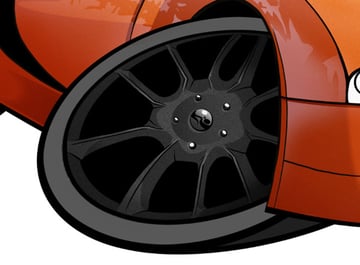
For the wheels of the car, we are going to add a little shade to these and not much highlight, every bit our main light source is coming from the correct side of the motorcar. To start nosotros shall go to our "L ine Work"layer and using the M agic Wand Tool select the inner rim on the forrad wheel.

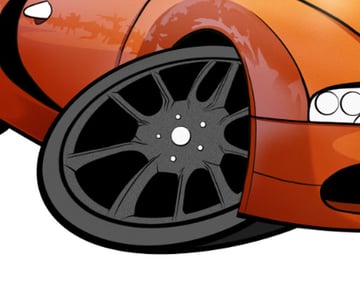
Step 2
Side by side, create a New "Multiply" Layer and fill the lower half of the wheel with a darker grey tone. It is a good idea to fix your G radient Tool Opacity to 40–50%.
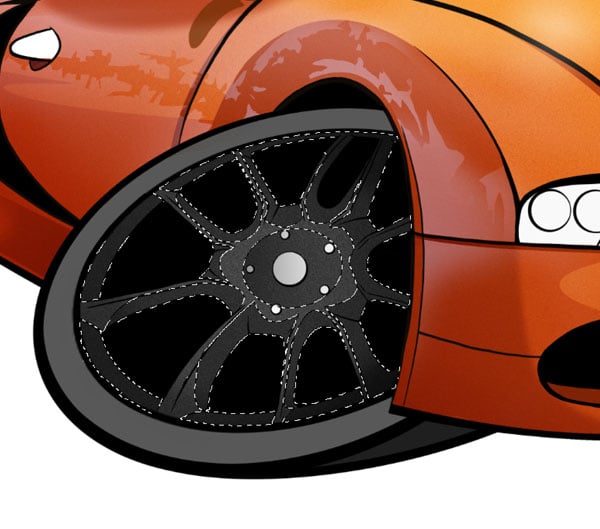

Step three
It would be worth your while using some solid night tones in some areas of the rims to show the sharp cutting of the rims. To create these you can use the P en Tool to draw out some selections demonstrated in the selection beneath, and and so fill these with a solid dark-grey tone using the P aint Saucepan Tool.

Step 4
Now repeat steps 1 to 3 for the rear bike too!


Step five
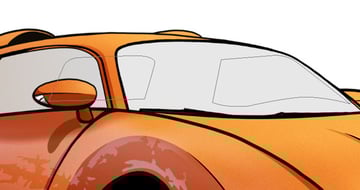
The interior of the machine needs to be defined a little scrap and then equally to not make the motorcar look besides plainly. To achieve this, have the P en Tool and draw out gaps that will mark out both the small rear window of the machine and the side window on the left side of the vehicle.

Step six
Now, you desire to fill your interior with a black tone using the G radient Tool going from left to right. Repeat the process for the seats, although yous should make these a little darker so they stand out a fiddling more. If the look you lot are after is not correct, be certain to Undo your gradient and try again.
Step vii
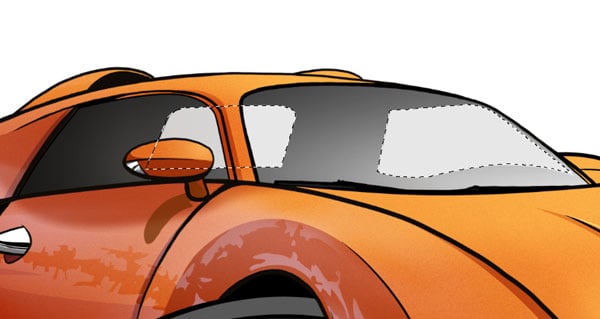
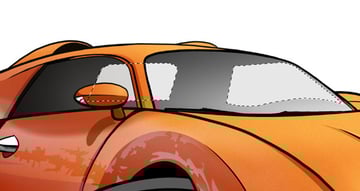
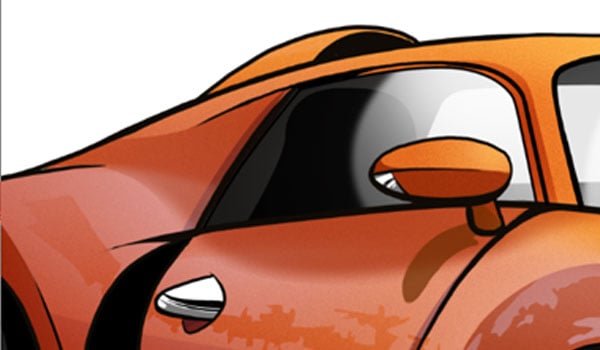
To create the right look for the drinking glass, you will demand to apply your Magic Wand Tool to select the areas of the windows in the "line piece of work" layer, and then in a carve up Due north ew Layer which needs to be prepare to "screen", use our 50 asso Tool and brand sure information technology has the F eathering set up to 25 px. And so, holding the Alt push button,de-select a small area in the left side of both the front and side windows. This will be our area of shadow.


Step 8
Using our Gr adient Tool, with a C ircular Gradient set up and with a low-cal-grey tone, drag your cursor from correct to left, filling your pick with tone. For the side window, separate fills may be required, only recollect the reflection volition non be as harsh in this window, so be conscientious with your fills. De-select your option in one case y'all are finished.
Step 9
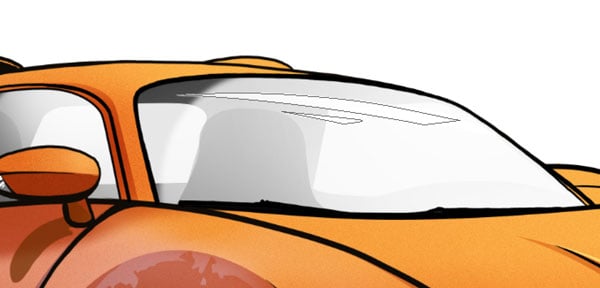
Next, using the P en Tool, carefully cut out two curves that will be a difficult reflection on our window. And then echo pace 7 by filling in with your Gradient Tool with a pure white tone. Make sure to de-select afterwards.
Step 10
For the lights, it is best to follow the same principles as for the interior above, carefully utilising the M agic Wand, Pen and Lasso Tools. A slice of important advice to take note of is that in the right light, your shadows volition be few, equally this cluster is bathed more in light than its contrary on the left which is more in shadow.


10. Work on the Background
Step 1
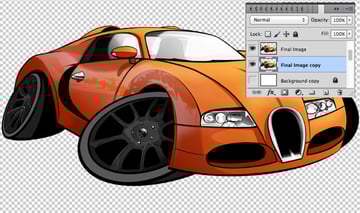
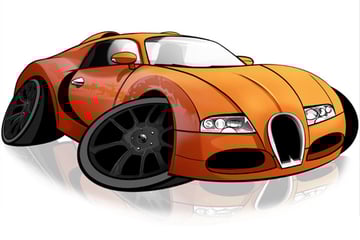
We should now take an image that is nearing completion, and all we need to do now is give the prototype a bit of temper. For such a fine auto equally this, a photography studio with a shiny white flooring would be a groovy choice, and to make this more realistic nosotros demand a reflection of the automobile on the floor.
To create this, offset hide your white background layer. So select your layer labelled "line work" and right click on this layer in50 ayer Hierarchy > Chiliad erge Visible.


Stride 2
Side by side, D uplicate this now merged layer and place it below our original one.

Step 3
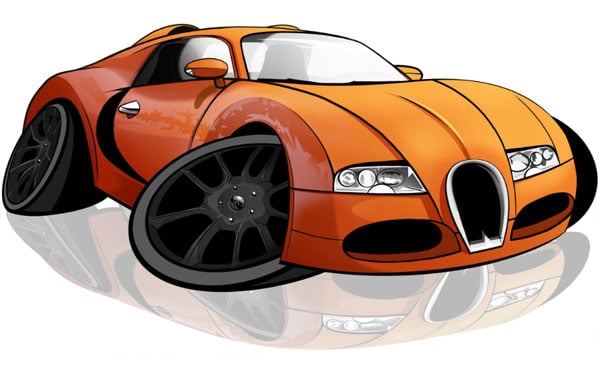
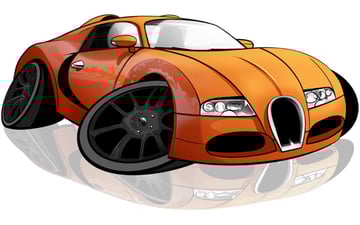
Nosotros now take our duplicate layer and demand to warp it so that information technology looks as if the auto is sitting on a mirrored flooring in the studio. To do this we become to the E dit button and go down to T ransform and to the S kew choice and, equally with our sketch layer earlier, y'all demand to pull the corners to give the impression of a reflection on the floor.
Y'all may likewise demand to select the S cale option to further warp this reflection until information technology meets the image we are looking for. Lastly, you demand to reduce the Opacity of this layer to around 25–35%. Using the Thou ove Tool, brand sure the image is positioned correctly on the canvas below the car.
Step 4
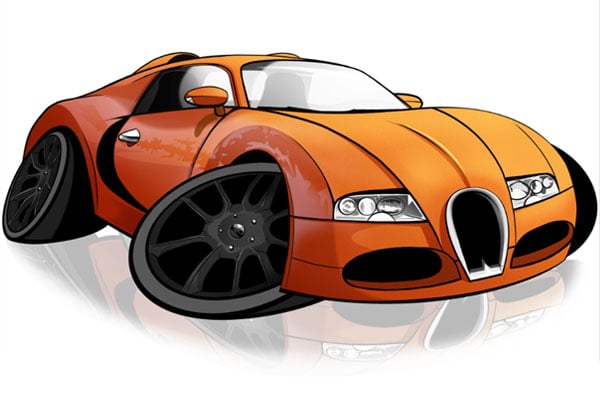
To stop our mirror result, accept the E llipse Marquee Tool merely, earlier drawing an ellipse, suit the F eather setting on the top toolbar to 40 px. In one case this is done, draw a large ellipse on the canvas and and then become to the S elect choice and click the I nverse selection. Clicking this choice volition flip your selection from the inside of the ellipse to the outside of it. From hither nosotros go to E dit and click the C ut option. Once this is washed we should have a faded result around the edge of the reflection, creating the finishing touch nosotros are looking to attain.
Pace five
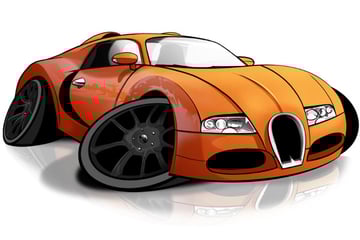
Nonetheless using our 50 asso Tool, carefully draw out a little area of shadow beneath the car. And so fill up the area using the Gradient Tool with showtime a mid-greyness tone and then a blackness tone to give the impression of deep shadow.

xi. Add the Finishing Touches
Step 1
At this stage, to really ready off the car's paintwork, it would be worth your while including a few specular (vivid white) highlights. You tin can create these in some other North ew Layer using the Gradient Tool set up at its Round option.


Step 2
Your illustration is now almost complete apart from i very of import stride, which is for you lot to add your signature to let everyone know that you have created this masterpiece!


Awesome Piece of work, Y'all're Done!
Creating cartoons and putting your own little spin on a existent-life object is always going to take a scrap of practice, and you might not become the result y'all are after get-go time. As you hopefully will accept seen throughout this tutorial, however, if you plan your drawing properly, use a bit of creative eye and in a higher place all accept intendance every bit you work, you will have a consequence that will please both those in the art globe and as well the occasional petrol head!

How To Draw People In A Car,
Source: https://design.tutsplus.com/tutorials/how-to-draw-ink-and-colour-a-cartoon-car-in-adobe-photoshop--cms-24697
Posted by: morrisboally.blogspot.com
0 Response to "How To Draw People In A Car"
Post a Comment