

How To Draw Time On A Clock
Telling the Time ESL Activities, Games and Worksheets
- Beginner (A1)
- Elementary (A1-A2)
- Pre-intermediate (A2)
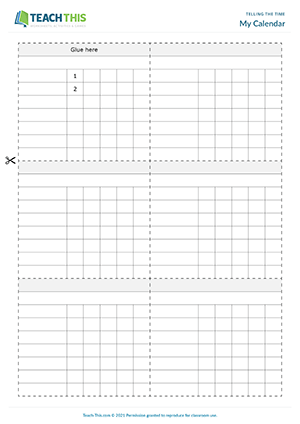
My Calendar
ESL Make a Calendar Action - Writing - Beginner (A1) - 60 minutes
In this make a calendar activeness, students make a calendar and make full information technology with special days or dates such as birthdays, festivals, national holidays, etc. To brainstorm, students larn and practice the rhyme "Thirty days have September". Next, students complete a calendar by writing in months, days of the calendar week and dates. When the calendar is complete, students add colour and pictures as desired, highlighting special days or dates such equally family unit members' birthdays, national holidays, etc. Students then cut out the calendar, stick it together and thread it with a piece of string so it can be hung up.

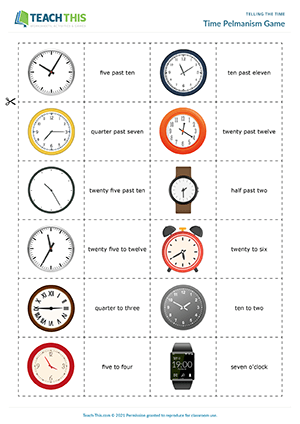
Time Pelmanism Game
ESL Telling the Time Games - Reading, Matching and Speaking Activities - Beginner (A1) - 20 minutes
In these 2 fun telling fourth dimension games, students match times to clock moving-picture show cards and practice saying the time. In pairs, students have it in turns to turn over one clock picture card and i discussion menu. If a pupil turns over a matching pair of cards, the educatee says the time, e.g. 'It'southward half past six'. The educatee then keeps the pair of cards and has some other plow. The student with the most pairs of cards at the cease of the game wins. Afterwards, students test each other on the times using the picture cards. The students have information technology in turns to pick up a clock picture card, bear witness information technology to their partner and enquire 'What'due south the time?' Their partner and then tells the time on the card. If the answer is correct, the student scores a indicate. The educatee with the nigh points at the end of the game wins.
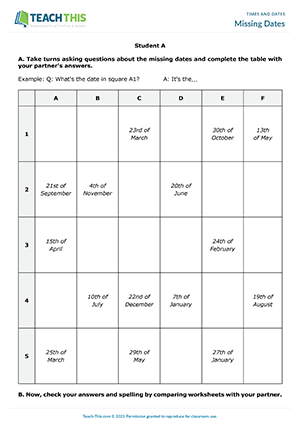
Missing Dates
ESL Dates Action - Reading, Writing, Listening and Speaking - Elementary (A1-A2) - 15 minutes
In this proverb dates activeness, students practice ordinal numbers, months and dates. In pairs, students have it in turns to ask questions about missing dates in a nautical chart on their worksheet and complete the chart with their partner's answers. When the students have finished, they cheque their answers and spelling by comparing worksheets with their partner.
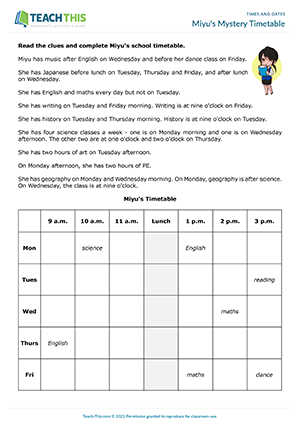
Miyu'due south Mystery Timetable
ESL School Timetable Worksheet - Reading, Matching and Writing Exercise - Uncomplicated (A1-A2) - 25 minutes
This timetable worksheet is ideal for practicing time, days of the calendar week and school subjects. Students read clues on the worksheet and complete the missing subjects in Miyu's schoolhouse timetable. Afterwards, draw the timetable on the board and arm-twist the answers from the class.
Interactive Version - Here is a schoolhouse timetable interactive worksheet to help students do fourth dimension, school subjects and days of the calendar week.
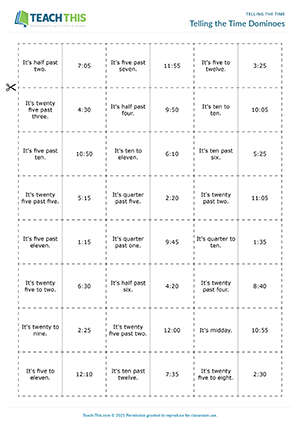
Telling the Time Dominoes
ESL Telling the Time Game - Reading and Matching Activity - Unproblematic (A1-A2) - 15 minutes
This fun telling fourth dimension game helps students do saying the fourth dimension with 'past' and 'to'. In the activeness, students play a game of dominoes where they lucifer written times to times on digital clocks. The first pupil puts a domino down either before or after the domino on the table, making sure the written time on 1 domino matches the digital clock on the other domino or vice-versa. The student and so reads the time aloud to the group for confirmation. If the times don't friction match, the student must have back the domino. Play then passes to the next pupil and then on. The first player to get rid of all their dominoes wins the game.
Telling the Time
ESL Telling The Fourth dimension Worksheet - Reading, Matching and Writing Exercises - Simple (A1-A2) - 25 minutes
In this engaging telling fourth dimension worksheet, students learn and practice telling the fourth dimension using numbers and expressions 'by' and 'to'. Students begin by matching fourth dimension expressions to the number of minutes 'before' or 'afterwards' the hour. Adjacent, students write times in numbers and then match clocks to times. After that, students draw times on blank clock faces. Following that, students write times in words using 'past' and 'to'. In the last exercise, students match times with 24-hour clocks.
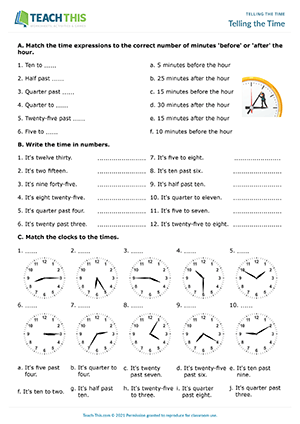
Interactive Version - This telling the time interactive worksheet contains a range of exercises to help students learn how to tell the time with 'past' and 'to'.
Terry's Timetable
ESL Timetable Activity - Reading, Writing, Listening and Speaking - Elementary (A1-A2) - 20 minutes
In this free school timetable activity, students practice telling the time, fourth dimension prepositions and schoolhouse subjects. In pairs, students take it in turns to inquire their partner questions and consummate missing subjects in Terry'due south school timetable. They do this by guessing which subject field from the worksheet Terry studies at a particular time, due east.g. 'Is the chemistry lesson at 9:30 on Monday?' When both students have finished, they bank check their answers by comparing timetables.
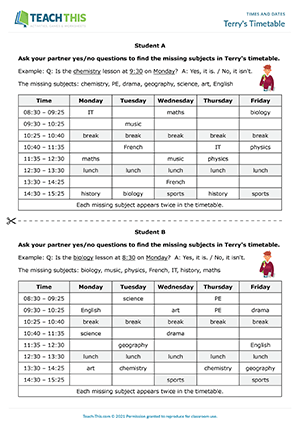


Interactive Version - In this free telling the fourth dimension breakout room activeness, students exercise telling fourth dimension and fourth dimension prepositions by guessing missing school subjects in a timetable and asking questions.
Time Around the World
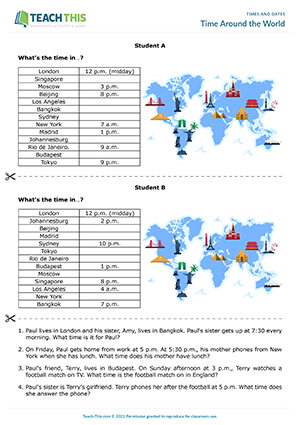
ESL Fourth dimension Around the World Activity - Reading, Listening and Speaking - Uncomplicated (A1-A2) - 25 minutes
In this time zones activity, students practise asking and answering questions about the time in unlike cities effectually the world. The students' task is to find out the time in cities around the globe when it is midday in London. In pairs, students take turns asking their partner questions most the missing time for each urban center on their worksheet, e.g. 'What'south the time in Singapore?' Their partner replies with the time shown on their worksheet, e.g. 'It's 8 p.g.' The student then writes the fourth dimension into the table. After, in pairs, students answer a prepare of fourth dimension zone questions.
Time Bingo
ESL Telling the Time Bingo - Listening and Speaking Activity - Unproblematic (A1-A2) - 30 minutes
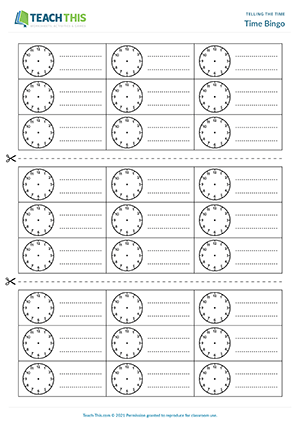
In this telling the time game, students play bingo using fourth dimension. To brainstorm, students draw a different time (o'clock) on each clock face on their bingo card, due east.g. i o'clock, five o'clock, etc. In the space side by side to each clock face, students write: in the morning time, in the afternoon, in the evening, midday or midnight. Next, telephone call out times as numbers with a.m. and p.thousand., e.g. 1 a.m. If the students accept a matching time on their card, they cantankerous it off. When a student has crossed off all nine times, they shout 'bingo' and read out the nine times using 'o'clock' and the time expression, e.thou. i o'clock in the morning. If the times are right, the student wins the round. If not, the game continues. Do a different time in each circular, e.thou. the next round could practice 'one-half past' and then on.
Timetable Battleships
ESL Time Telling Game - Writing, Listening and Speaking Activity - Elementary (A1-A2) - 25 minutes
In this free telling the time game, students play battleships by trying to find six English lessons in a partner'southward schoolhouse timetable. To first, students write six English lessons into the empty timetable on the worksheet. Students fill up in the empty squares with other school subjects, eastward.g. history, chemistry, etc. Students then play a game of battleships where they accept information technology in turns to ask their partner what they study at item times and write the answers in their partner'due south timetable on the worksheet. The first person to observe all half dozen of their partner'southward English language lessons is the winner.
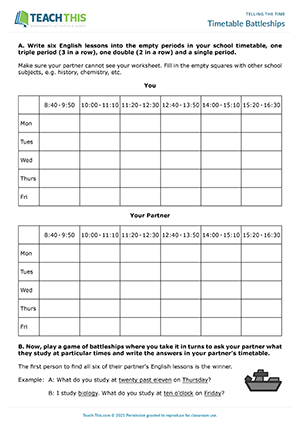

Interactive Version - In this free telling time breakout room game, students do maxim times by trying to find English language lessons in a classmate's school timetable.
Vocabulary Clocks
ESL Telling the Fourth dimension Game - Spelling and Speaking Activity - Elementary (A1-A2) - 25 minutes
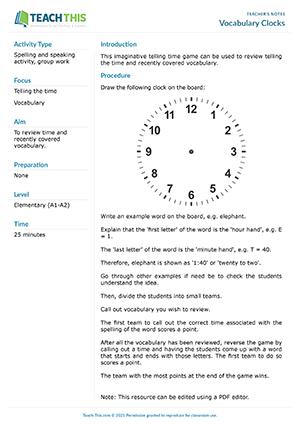
This imaginative telling time game tin can exist used to review telling the time and recently covered vocabulary. Draw a clock on the lath. Next to each number, write letters of the alphabet. The beginning letter of the word is the hour hand and the final letter of the word is the minute hand. Telephone call out a give-and-take. The teams then race to call out the correct fourth dimension. The first squad to call out the correct time associated with the spelling of the give-and-take scores a indicate. After all the vocabulary has been reviewed, the game is reversed. Call out a fourth dimension and the teams come upward with a discussion that starts and ends with those letters. The first team to do this scores a bespeak. The squad with the well-nigh points at the end of the game wins.
When is your birthday?
ESL Saying Dates Activeness - Listening and Speaking - Uncomplicated (A1-A2) - 20 minutes
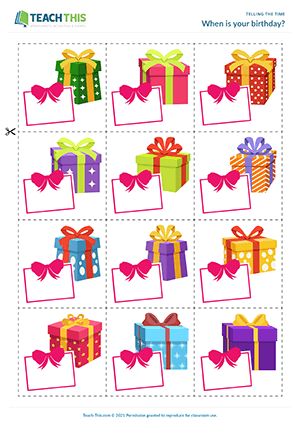
In this saying dates action, students practice asking and answering questions about birthdays. Give each educatee a menu that shows a gift-wrapped present and a label. Students write the date of their birthday on the label. Collect in the cards and so redistribute them so each student has someone else'south birthday on a card. Students imagine what is under the gift-wrapping of the present (e.thousand. a box of chocolates) and write the present on the dorsum of the card. The students' task is to find out who their present is for and to give it to them. To practise this, students walk around the grade asking 'When is your birthday?' until they find the person who has the same birthday as the one shown on their carte. When a student finds the owner of the card, they give information technology to them and explain what the present is, e.chiliad. 'I bought you a box of chocolates. I hope yous like them'. Afterwards, there is a class feedback session to find out what present each student received and if the students similar their presents.
Hear and Say
ESL Time Game - Reading and Listening Activity - Pre-intermediate (A2) - xx minutes
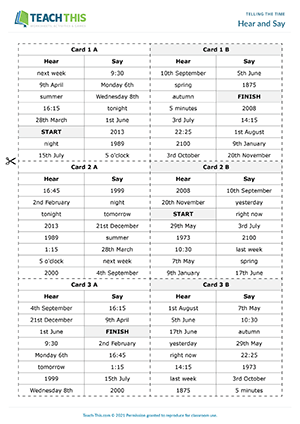
This entertaining fourth dimension game helps students review and practice telling the fourth dimension, time prepositions and saying days, months, years, dates and other time expressions. The student with 'offset' on their carte begins past saying the time expression indicated in the 'Say' column next to 'beginning'. The other students in the group listen carefully and try to observe the time expression in the 'Hear' cavalcade on their cards. If a student sees a matching time in the 'Hear' column, they say the respective time expression in the 'Say' cavalcade for the other students to recognise. Students must add in whatever prepositions of fourth dimension or articles that are necessary, e.1000. the 28th of March, Monday the 6th, in 2022, etc. If they take a fourth dimension, e.g. sixteen:45, they say the time every bit 'quarter to five' rather than just reading the number. Play passes from educatee to student until they reach the finish. Students and then repeat the game with another set of cards.
Just Another Day
ESL Telling the Time Activity - Listening and Speaking - Pre-intermediate (A2) - 30 minutes
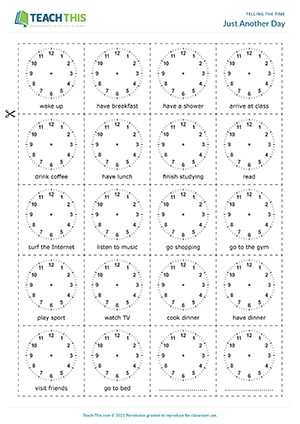
In this complimentary telling the time activity, students practise saying times and using the present simple to depict a partner's everyday activities. First, students choose cards that evidence the activities they practice on a normal day and indicate when they do each activity by cartoon the time on the clock. Next, students commutation cards with a partner and layout their partner'southward activities in order, co-ordinate to the times on the clocks. Students and so take information technology in turns to expect at their partner's cards and describe their normal day, due east.g. 'You wake up at half past half dozen. You lot have breakfast at vii o'clock, etc.' Afterwards, students find differences in what they practice every day, due east.g. 'I wake upwardly at 7 o'clock, just y'all wake up at half by seven'. Next, students take their partner's activity cards and work with a new partner. This time, students layout their original partner'south cards in the correct lodge and describe his or her normal day to their new partner using the third-person singular.
Our Fourth dimension
ESL Telling Fourth dimension Activity - Writing, Listening and Speaking - Pre-intermediate (A2) - 45 minutes
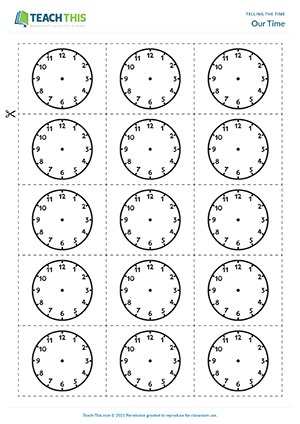
In this telling the fourth dimension activity, students practice telling the fourth dimension and describing a particular time'due south importance. Each student writes the names of everyone in the class on a piece of newspaper and is given a clock carte du jour. On the clock face, students depict a time that is important to them. Students so go around the classroom asking and telling each other the time on their clock. Every fourth dimension a student asks another student for their fourth dimension, they detect out why it is important. The educatee notes down the time next to the proper noun of the student on their paper and the reason for its importance. In pairs, students so put the names of everybody in the grade in order, according to who had the primeval to latest time on their clock. Students also write a judgement for each educatee most what they do at that time, east.grand. 'At half past seven, Steve arrives at the bus stop. At quarter past eight, Kim has breakfast, etc.' Afterwards, there is a class feedback session to review the correct order and answers with the grade.

Source: https://www.teach-this.com/general-activities-worksheets/time
Posted by: morrisboally.blogspot.com
0 Response to "How To Draw Time On A Clock"
Post a Comment